
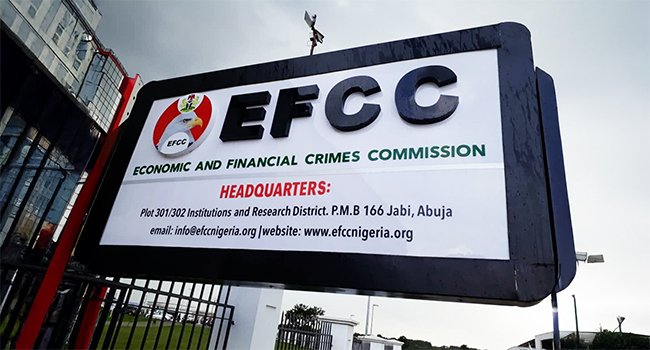

The Economic and Financial Crimes Commission (EFCC) says it recovered ₦1.233 trillion and secured 10,872 convictions between October 2023 and June 2026, highlighting the scale of its enforcement and asset-recovery operations under Chairman Ola Olukoyede.
Olukoyede disclosed the figures on Monday, August 31, 2026, during a media briefing in Abuja where he presented an account of the commission’s activities since assuming office. The EFCC said the recoveries covered proceeds linked to financial crimes and involved government institutions, individuals and corporate entities.
The commission also reported foreign-currency recoveries during the period, including $684.48 million, £373,905.78 and €9.34 million.
The naira recovery figure represents one of the most significant elements of the EFCC’s three-year performance report.
According to figures reported from the briefing, ₦397.26 billion of the naira recoveries was classified as money recovered directly for the Federal Government. A further ₦836.35 billion was recovered on behalf of ministries, departments, agencies, corporate organisations, individuals and other beneficiaries.
That distinction is important because the headline recovery figure does not represent money that all flowed directly into federal government coffers.
EFCC Recovery Figures at a Glance
- ₦1.233 trillion: Naira recoveries
- $684.48 million: Dollar recoveries
- £373,905.78: Pound sterling recoveries
- €9.34 million: Euro recoveries
- 10,872: Convictions secured
- 14,476: Cases filed, according to contemporaneous reporting
The EFCC said its enforcement activities covered a broad range of economic and financial offences.
The commission’s enforcement portfolio extends beyond conventional fraud cases.
The offences identified by the EFCC include advance-fee fraud, bank fraud, economic and governance-related fraud, money laundering, procurement fraud, cybercrime, extractive-industry fraud, land and property fraud and tax-related offences.
The breadth of the categories reflects the commission’s expanding role in pursuing financial crimes that affect both public finances and the private sector.
The EFCC has also increasingly focused on asset tracing and recovery as a central component of its enforcement strategy. Rather than relying solely on convictions, the agency has sought to recover assets and funds allegedly connected to criminal activity.
That approach has made the management and eventual disposal of recovered assets an important part of the commission’s operations.
Olukoyede also addressed criticism and questions surrounding the commission’s recent policy on the auctioning and management of recovered assets.
The EFCC chairman defended the policy, saying the commission’s actions fall within its responsibilities under the Proceeds of Crime Act (POCA).
The law provides a framework for the recovery and management of proceeds of unlawful activity. The EFCC’s position is that recovered assets must be handled within the legal structure governing proceeds of crime rather than through an ad hoc process.
The issue is significant because the value of assets recovered by anti-graft agencies has increased the importance of transparent procedures for preservation, forfeiture, management and eventual disposal.
The commission also provided an update on investigations involving Bureau de Change operators.
According to the EFCC, 234 cases involving BDC operators are currently under investigation, while 72 convictions have been secured in related enforcement efforts.
The focus on BDC operations comes amid the commission’s broader scrutiny of financial channels that can facilitate illicit movement of funds.
The sector has historically attracted regulatory attention because of its role in foreign-exchange transactions and the potential for financial crimes to exploit informal or poorly monitored channels.
The EFCC’s figures indicate that enforcement in this area remains an active part of its broader campaign against economic and financial crimes.
Beyond its recovery and prosecution figures, the commission announced plans to establish a 24-hour rapid-response centre by September.
The facility is expected to provide members of the public with a channel for reporting suspected economic and financial crimes.
The planned centre could strengthen the commission’s ability to receive intelligence and respond to allegations outside conventional working hours. It also places greater emphasis on public participation in identifying suspected financial crimes.
The EFCC’s mission includes prevention, enforcement and coordination in the fight against economic and financial crimes.
Olukoyede also disclosed that the commission had dismissed 50 members of staff during the past three years, with five of those officials facing prosecution.
The disclosure provides an indication of the EFCC’s stated effort to address misconduct within its own ranks while pursuing financial crimes outside the organisation.
Internal accountability remains particularly important for an anti-corruption agency because the credibility of investigations and prosecutions depends partly on public confidence in the integrity of its personnel.
The commission’s leadership has therefore placed institutional reforms alongside investigations, prosecutions and asset recovery as part of its wider agenda.
The EFCC’s latest figures provide a snapshot of the scale of financial-crime enforcement under Olukoyede, but the value of recoveries alone does not fully measure the effectiveness of an anti-graft campaign.
Questions around how recovered funds are ultimately returned to beneficiaries, how forfeited assets are managed and whether recovered proceeds translate into measurable economic benefits remain important.
The distinction between direct government recoveries and funds recovered on behalf of other beneficiaries is also crucial when assessing the commission’s ₦1.233 trillion figure.
At the same time, the reported 10,872 convictions point to substantial prosecutorial activity during the period.
The latest performance report comes as the EFCC continues to face expectations to demonstrate that asset recovery produces tangible benefits for Nigerians.
Recovering funds is only one stage of the process. The subsequent handling of recovered money and property, compliance with court orders and transparency in asset disposal will remain central to public scrutiny.
For the commission, the next phase will involve sustaining prosecutions, improving intelligence gathering, recovering illicit assets and strengthening institutional controls.
Olukoyede’s latest figures therefore offer both a measure of the EFCC’s enforcement activity and a benchmark against which its future performance can be assessed. The commission’s ability to convert recoveries into legally accounted-for restitution and broader economic value will ultimately determine how significant the figures become beyond the headline numbers.