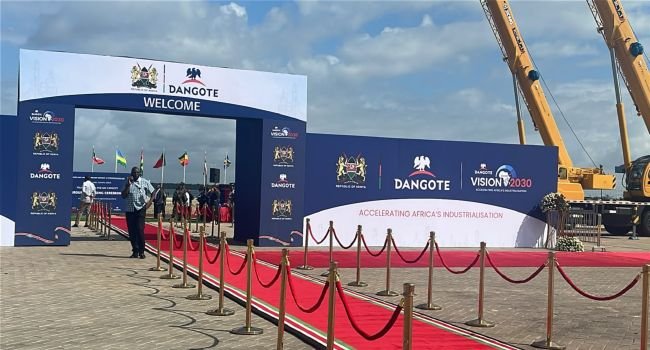

The Dangote Kenya refinery project has reached a major construction milestone as Nigerian industrialist Aliko Dangote and Kenyan President William Ruto launch the $16 billion facility in Lamu on Wednesday, September 30, 2026.
The refinery, planned for the Lamu Port area, is designed to process up to 700,000 barrels of crude oil per day when fully operational. Its developers expect the facility to supply refined petroleum products to Kenya and other East African markets while reducing the region’s dependence on imported fuel.
The project represents Dangote’s second major refinery venture in Africa, following the development of his 700,000-barrel-per-day facility in Lagos, Nigeria.
However, the groundbreaking comes against the backdrop of a legal dispute involving residents who have challenged aspects of the land arrangements surrounding the proposed refinery.
The Dangote Kenya refinery is being developed as a regional energy project rather than a facility designed exclusively for the Kenyan market.
The plant is expected to process crude from Kenya’s Lokichar fields and other African and international sources before supplying petroleum products across East Africa. The project is also expected to support additional industrial activities, including petrochemicals and related manufacturing.
At full capacity, the refinery would rank among Africa’s largest refining facilities and significantly expand East Africa’s domestic petroleum-processing capability.
Key features of the project include:
- Estimated investment: $16 billion
- Planned location: Lamu, Kenya
- Processing capacity: 700,000 barrels of crude oil per day
- Target market: Kenya and wider East African markets
- Expected completion: Around 2030
- Related industries: Petrochemicals, chemicals and other downstream businesses
Kenyan authorities have positioned the investment as part of efforts to transform Lamu Port into a major regional logistics and energy hub.
Preparations for construction had moved beyond planning before Wednesday’s ceremony.
The Port of Lamu received about 2,930 metric tonnes of heavy construction machinery aboard the vessel MV Da Yang days before the groundbreaking. Kenya News Agency reported that the arrival demonstrated the port’s readiness to handle specialised cargo associated with the refinery’s construction.
The project is located within the Lamu Port-South Sudan-Ethiopia Transport (LAPSSET) Corridor, giving it a strategic connection to Kenya’s wider infrastructure and trade plans.
The refinery could also increase demand for port services, petroleum transportation, storage, engineering, construction and other supporting businesses as development progresses.
Kenyan officials have said the facility could help strengthen Lamu’s role as an energy and logistics centre serving markets beyond Kenya.
The project also carries a regional ownership component.
Dangote has offered East African governments a combined 30% stake in the planned refinery, creating a structure intended to give participating countries a direct financial interest in the facility. Reuters reported that Rwanda has expressed interest in taking a share, while other regional governments have also been involved in discussions.
The proposed ownership structure could make the refinery more closely tied to the region’s energy-security strategy while providing governments with exposure to the project’s future commercial returns.
Dangote has also indicated that the project would be financed through a combination of equity and debt. Earlier estimates placed the investment at as much as $17 billion before the projected cost was revised to roughly $15.5 billion-$16 billion.
The groundbreaking is taking place despite a legal dispute over the land earmarked for the refinery.
A Kenyan court ordered parties to maintain the status quo concerning the disputed property after 133 residents filed a case challenging aspects of the development. The petitioners raised concerns involving ancestral land claims, compensation and environmental requirements.
Reuters reported that the court order could affect some site activities, although Dangote said it would not prevent the scheduled groundbreaking ceremony. A further court hearing is expected in October.
The dispute means that land rights, environmental compliance and community engagement will remain important issues as construction moves forward.
East African countries currently rely heavily on imported refined petroleum products. A large-scale refinery in the region could alter that supply structure by bringing substantial refining capacity closer to major consuming markets.
The project is also expected to stimulate investment around Lamu Port and the wider LAPSSET corridor.
If construction proceeds according to schedule, the refinery could create tens of thousands of direct and indirect jobs and support businesses across logistics, construction, engineering, energy and manufacturing. Reuters reported that project expectations include more than 50,000 jobs.
The longer-term impact will depend on several factors, including crude supply, financing, infrastructure development, environmental approvals and the resolution of outstanding land issues.
The Lamu development follows the establishment of Dangote’s large-scale refinery in Lagos.
Dangote’s Nigerian refinery has a crude-processing capacity of 700,000 barrels per day and is integrated with storage, marine infrastructure and petrochemical operations. The company says the facility has been designed to serve both Nigerian and international markets.
The Kenyan project extends that refining strategy into East Africa and could give Dangote a second major platform for supplying refined petroleum products on the continent.
For Kenya, meanwhile, the refinery forms part of a broader ambition to develop Lamu as a major industrial and maritime centre.
The Dangote Kenya refinery has now moved from a long-running proposal into its construction phase, with the $16 billion investment positioning Lamu at the centre of East Africa’s refining ambitions.
The project’s scale, regional ownership structure and proposed 700,000-barrel-per-day capacity make it a significant development for the continent’s downstream oil industry. But its progress will also depend on resolving the ongoing land dispute and ensuring reliable crude supplies, financing and supporting infrastructure.
If completed as planned, the Lamu refinery could substantially reshape how petroleum products are processed and distributed across East Africa by the end of the decade.