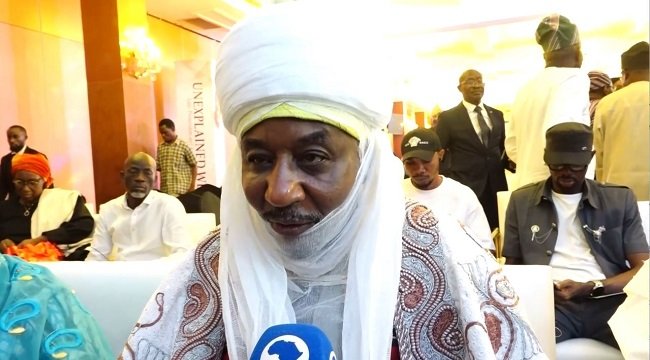

The Emir of Kano, Muhammadu Sanusi II, has criticised the influence of political connections on the enforcement of Nigerian laws, arguing that powerful networks can make it difficult to hold people accountable for alleged wrongdoing.
Sanusi made the remarks on Monday, September 28, 2026, in Lagos during the public presentation of “Unexplained Wealth: A Trilogy of Nigerian Financial Law,” a three-volume publication authored by Senior Advocate of Nigeria, Wahab Shittu.
The event brought together prominent figures, including former President Olusegun Obasanjo and former Vice President Yemi Osinbajo, for discussions on corruption, unexplained wealth, institutional accountability and the enforcement of financial laws.
Sanusi’s central argument was that Nigeria’s challenge is not necessarily a shortage of legislation. Rather, he questioned whether existing laws are applied consistently, particularly when individuals involved have strong political relationships.
He said the effectiveness of anti-corruption legislation ultimately depends on institutions having the independence and capacity to enforce the law without political interference.
The Emir’s comments came against the backdrop of renewed national debate over how Nigeria investigates and prosecutes allegations involving politically exposed persons.
Sanusi argued that the existence of laws against corruption and financial misconduct does not automatically guarantee accountability. In his view, enforcement becomes critical when institutions must investigate individuals with access to political power.
His remarks centred on a broader institutional question: whether Nigeria’s legal framework is strong enough to withstand political pressure.
The issue is particularly relevant to anti-corruption agencies, courts and other public institutions responsible for investigating alleged financial crimes.
The event’s focus on unexplained wealth also highlighted concerns about how authorities can trace assets whose sources cannot be adequately established and distinguish legitimate wealth from proceeds allegedly obtained through unlawful means.
Author Wahab Shittu said unexplained wealth remains a significant obstacle to Nigeria’s development, arguing that the country loses resources through wealth accumulation that cannot be satisfactorily accounted for.
The central issues raised at the Lagos event included:
- Enforcement of Nigeria’s existing financial and anti-corruption laws.
- Accountability for unexplained wealth.
- Independence of public institutions.
- Consistency in investigating allegations of corruption.
- Protection of due process in criminal investigations.
- The effect of political influence on institutional decision-making.
Sanusi’s remarks have particular relevance to ongoing legal proceedings involving former Kaduna State Governor Nasir El-Rufai, whose case has generated debate over the application of anti-corruption laws.
The Independent Corrupt Practices and Other Related Offences Commission (ICPC) charged El-Rufai and another defendant before the Federal High Court in Kaduna over alleged offences including abuse of office, money laundering and fraud. Both defendants pleaded not guilty.
The ICPC has maintained that its investigation and subsequent proceedings are being conducted according to legal procedures.
In an earlier statement, the commission said El-Rufai’s detention was authorised by a court and that it was complying with the relevant remand order.
The former governor has separately challenged actions taken by authorities in court.
In September, the Federal High Court in Abuja adjourned his ₦1 billion fundamental-rights suit against the ICPC, Inspector-General of Police and Attorney-General of the Federation until October 27, 2026. The suit concerns the search of his Abuja residence and allegations that his constitutional rights were violated.
These proceedings remain before the courts, meaning allegations against El-Rufai have not been established as facts by a final judgment.
Sanusi’s intervention at the Lagos event was broader than the circumstances surrounding any single investigation.
His comments addressed a longstanding governance question: whether institutions can apply laws impartially when those under investigation have significant political or social influence.
That question has implications for several institutions, including:
Anti-graft agencies
Bodies such as the ICPC and Economic and Financial Crimes Commission are expected to investigate suspected financial crimes while operating within their statutory mandates and respecting due process.
The judiciary
Courts remain responsible for determining whether evidence supports criminal allegations and whether defendants’ constitutional and procedural rights have been respected.
Political institutions
Elected officials and political actors influence public policy, but the enforcement of criminal law is expected to operate through established legal institutions rather than informal political relationships.
The debate therefore extends beyond whether particular individuals should be investigated or prosecuted. It concerns whether the same legal standards are applied regardless of a person’s political status or connections.
The Lagos discussion also focused on unexplained wealth as a broader economic and governance issue.
Shittu argued that unexplained wealth can undermine national development by diverting resources away from productive economic activity and weakening public confidence in institutions.
Former President Olusegun Obasanjo similarly used the event to stress the relationship between corruption and development, arguing that the consequences of corruption ultimately affect ordinary citizens.
For Nigeria, the issue has implications beyond criminal prosecution. Effective asset recovery, transparent public procurement, financial disclosure, investigative capacity and judicial efficiency all influence how successfully authorities can tackle illicit enrichment.
Sanusi’s intervention therefore adds to a wider conversation about whether institutional reforms can produce consistent results rather than relying primarily on individual political leaders.
The key issue emerging from Sanusi’s comments is the difference between having laws on paper and enforcing them consistently.
Nigeria has developed an extensive legal framework covering corruption, money laundering, abuse of office and other financial offences. Yet public confidence depends significantly on how those laws operate in practice.
The ongoing cases involving politically exposed persons will continue to test that framework.
For the government and anti-corruption institutions, the challenge is to demonstrate that investigations and prosecutions follow established procedures, while defendants retain their rights to due process and fair hearing.
For the courts, the ultimate responsibility remains the determination of contested allegations based on evidence presented before them.
Sanusi’s warning consequently places institutional independence at the centre of the country’s continuing debate over corruption and unexplained wealth.
The broader test for Nigeria will be whether its institutions can apply financial and criminal laws consistently, transparently and without regard to the political influence of the people involved.