
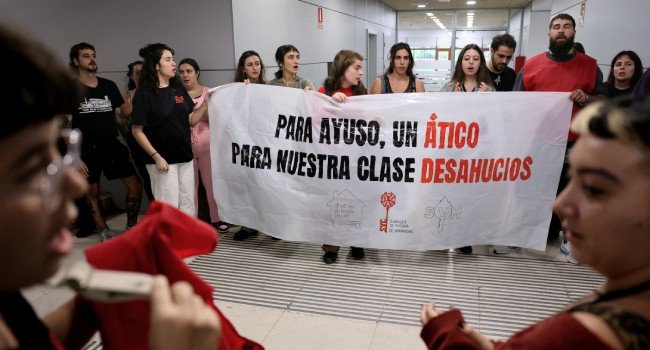

Protesters in Madrid have entered a third day of demonstrations over Spain’s worsening housing crisis, maintaining a tent camp in the capital’s Puerta del Sol and demanding stronger protection for tenants after the eviction of an 87-year-old woman from her long-time home.
The Madrid Tenants’ Union is leading the mobilisation, which intensified after María del Carmen Abascal, widely known as Maricarmen, was removed from her apartment in Madrid’s Retiro district last week following an eviction order. The incident has become a focal point for wider anger over rising rents, housing shortages and tenant insecurity.
The demonstrations continued on Monday, September 28, 2026, as protesters sought to keep pressure on Prime Minister Pedro Sánchez’s government ahead of a cabinet meeting expected to consider new housing measures. Sánchez has said his government is working to bring forward a housing decree on Tuesday.
Hundreds of protesters have remained in Puerta del Sol, with tents occupying the central Madrid square after Saturday’s large demonstration.
The campaign has transformed the dispute from a single eviction case into a broader protest over housing affordability and tenant rights.
The Madrid Tenants’ Union has demanded measures including:
- Stronger protection against evictions.
- Greater security for renters.
- Action to curb rapidly rising rents.
- Restrictions on evictions where no alternative accommodation is available.
- Measures addressing alleged abuses in the rental market.
- Greater availability of affordable housing.
The scale of Saturday’s demonstration is disputed. Spain’s government delegation estimated that about 25,000 people participated in Madrid, while the Madrid Tenants’ Union claimed the number was as high as 300,000. Protests linked to the housing campaign were also reported in other Spanish cities.
The continued occupation of Puerta del Sol has given the campaign additional visibility because the square was the centre of Spain’s 15-M protest movement in 2011.
The immediate trigger for the latest mobilisation was the eviction of Maricarmen Abascal, who had lived in the same Madrid apartment for about seven decades.
Reports said she was removed from the property on a stretcher after police carried out the eviction. Her case drew widespread attention and prompted protesters to use her experience as an example of what they describe as inadequate tenant protection.
According to reporting cited by AP, the apartment’s ownership changed in 2018. The Madrid Tenants’ Union said the subsequent owner raised Abascal’s rent substantially, leaving the elderly tenant unable to afford the property on her pension.
The eviction has since become a rallying point for protesters under the message “Not one more Maricarmen.”
The case has also exposed differences within Spain’s governing coalition over how authorities should respond.
Sánchez’s Socialist-led government has faced pressure from left-wing coalition partner Sumar, which has advocated stronger intervention in the case. Government officials have questioned whether some of the proposed measures, including expropriation, would fit within Spain’s constitutional framework.
The protests are taking place against a housing market where supply has failed to keep pace with demand in several major Spanish cities.
Reuters reported Monday that average rents in Spain have roughly doubled over the past decade, while the country’s central bank has estimated a housing deficit of about 750,000 homes. Reuters also reported that Spain currently builds around 120,000 homes annually, considerably below pre-2008 financial-crisis levels.
Other recent estimates have put the shortage lower, illustrating the differences between methodologies and reporting periods. AP cited a Bank of Spain estimate of approximately 550,000 homes for the previous year.
Public housing availability is another major concern.
AP reported that publicly subsidised rental housing accounts for less than 2% of Spain’s housing stock, compared with an EU average of about 8%.
The pressure is particularly pronounced in large urban centres, where population growth, tourism and limited housing construction have contributed to higher housing costs.
Prime Minister Pedro Sánchez has responded to the protests by saying his administration is working urgently on a new housing decree.
Speaking at a Socialist Party event in Getafe on Sunday, Sánchez said his government was working to take the proposed measures to the Council of Ministers on Tuesday. He also called for parliamentary groups to make a further effort to secure support for the legislation.
The government’s proposed response will now face close scrutiny from protesters, who have indicated that a limited package may not satisfy their demands.
The Tenants’ Union has called for more substantial measures, including action on rents and eviction protections. Organisers have also warned that approving a government proposal may not automatically bring the occupation of Puerta del Sol to an end.
This leaves the government facing pressure on two fronts: responding to the immediate political impact of the Maricarmen case while addressing a housing problem that has developed over years.
The next major test is expected on Tuesday, when Spain’s cabinet is scheduled to consider the government’s proposed housing measures.
Several developments could shape the next phase of the protests:
- Whether the government approves the proposed housing decree.
- The scope of any rent or tenant-protection measures.
- Whether the measures secure sufficient parliamentary backing.
- Whether protesters accept the government’s response.
- Whether the Puerta del Sol encampment continues beyond Tuesday.
- How the dispute affects Spain’s political debate ahead of the 2027 general election.
The choice of Puerta del Sol also gives the protests historical significance. The square became internationally recognised during the 15-M movement, when demonstrators occupied it for weeks in 2011 amid anger over austerity, unemployment and the economic crisis.
The current movement has a different immediate trigger, but its central concern is again economic insecurity.
For protesters, the eviction of an elderly tenant has become a symbol of a broader housing problem. For the Sánchez government, Tuesday’s proposed measures will provide an early test of whether it can translate its pledge to address the crisis into policies that satisfy both coalition partners and an increasingly vocal housing movement.
The Madrid housing crisis is therefore likely to remain a major political and social issue as Spain moves toward the 2027 election.