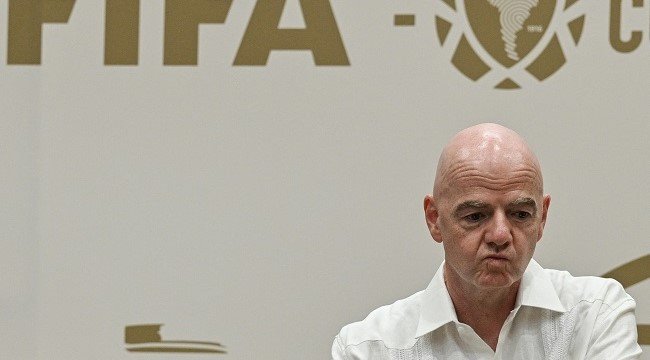

FIFA President Gianni Infantino is facing another major challenge to his leadership after Hungarian football chief and FIFA Vice President Sándor Csányi withdrew his support for Infantino’s bid for a fourth term, citing a serious breakdown in confidence within football’s governing body.
Csányi’s decision, disclosed in a letter seen by AFP on Wednesday, August 19, 2026, represents an important escalation because he is not simply a national association leader but also a member of FIFA’s ruling council. He said recent events had caused him to lose the confidence he previously placed in Infantino.
The dispute centres on the collapse of FIFA’s controversial proposal to bring private investment into the commercial operations surrounding the World Cup and other competitions, as well as the subsequent dismissal of FIFA Chief Operating Officer Kevin Lamour.
Lamour had publicly criticised the investment proposal before FIFA abandoned it, while his removal triggered further concern among senior football officials about governance and decision-making at the organisation.
The dismissal of Lamour has become a defining issue in the latest dispute surrounding Infantino.
The French executive had broken ranks with FIFA’s leadership by criticising the proposed private-investment model. FIFA subsequently abandoned the initiative, but Lamour’s removal continued to generate criticism from senior figures within European football.
Csányi described the decision to remove Lamour as a particularly significant moment in his loss of confidence in Infantino. Reuters reported that the Hungarian official regarded the episode as the point at which his concerns reached a critical level.
The controversy has raised broader questions about transparency and consultation within FIFA.
Critics of Infantino have focused on several issues:
- The process used to develop the private-investment proposal.
- The lack of consultation with some FIFA stakeholders.
- The decision to dismiss Lamour after his criticism.
- Concerns about the concentration of authority within FIFA’s presidency.
- Calls for an independent review of the organisation’s governance.
The growing disagreement means the controversy is no longer confined to external critics. It is increasingly being expressed by people occupying senior positions within FIFA’s own structure.
Csányi’s decision follows a series of withdrawals of support for Infantino ahead of the FIFA presidential election scheduled for March 2027.
Several national associations have already distanced themselves from the FIFA president. New Zealand Football withdrew its backing earlier in August, while football authorities in England, Wales, Scotland, Ireland and Israel have also taken positions against supporting Infantino’s re-election.
The sequence has created an increasingly difficult political environment for the FIFA president.
UEFA, the Asian Football Confederation and CONCACAF have also called for a review of FIFA leadership following the collapse of the investment proposal. The three confederations criticised the way the project was handled and raised concerns about trust and governance.
The developments do not, however, mean Infantino has lost the support needed to remain in office.
Despite the growing opposition, Infantino retains significant backing elsewhere in world football.
The Confederation of African Football (CAF) and South America’s CONMEBOL remain supportive, while several football associations in other regions have not withdrawn their backing.
A senior Infantino ally, FIFA executive Véron Mosengo-Omba, recently argued that the FIFA president still enjoys support from a majority of football associations, although he acknowledged disagreements over the failed investment plan.
That division makes the upcoming FIFA election particularly significant.
FIFA has 211 member associations, meaning a candidate needs a majority of the votes at Congress to secure the presidency. Infantino is seeking a fourth term, but the withdrawals from several associations indicate that the campaign could become considerably more contested than previously expected.
The immediate challenge for Infantino is political rather than simply numerical.
The loss of support from Csányi carries additional weight because he sits within FIFA’s governing structure. It also reinforces concerns that the opposition is spreading beyond individual national associations and into FIFA’s leadership circles.
For Infantino, rebuilding confidence will likely require more than defending his record. The controversy has placed FIFA’s internal decision-making, transparency and consultation processes under sustained scrutiny.
The abandoned investment plan has already become a central issue in the dispute. Several football bodies want an independent examination of how the proposal was developed and presented.
Infantino remains the frontrunner for FIFA’s 2027 presidential election, but the recent defections have changed the political landscape around his campaign.
The coming months will determine whether the current opposition consolidates into a coordinated challenge or remains divided across different confederations and national associations.
For now, Csányi’s withdrawal represents another warning sign for Infantino. With FIFA officials and member associations increasingly questioning the organisation’s governance, the president faces the task of restoring confidence before voters gather for the next presidential election.
The central question is no longer simply whether Infantino intends to seek another term. It is whether he can rebuild enough trust across FIFA’s increasingly divided membership to secure it.