
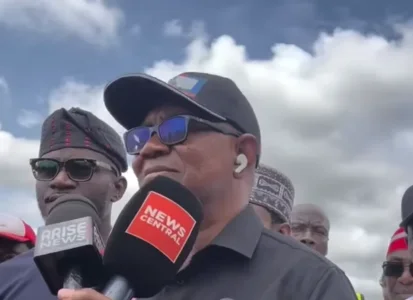

The Benue State Government has denied involvement in the disruption of Peter Obi’s planned visit to Yelwata, accusing the presidential candidate of the Nigeria Democratic Congress (NDC) of making unfounded allegations against Governor Hyacinth Alia’s administration.
The dispute followed an incident in Makurdi on Tuesday, September 8, 2026, when youths reportedly stopped Obi’s convoy as he travelled towards Yelwata in Guma Local Government Area to meet families affected by the deadly June 2025 attack.
Obi alleged that the youths were acting on the orders of a state government aide and said he was forced to abandon the visit to avoid a confrontation that could endanger lives.
The state government, however, rejected the allegation and said it neither organised nor authorised anyone to obstruct the former Anambra State governor.
The Benue Police Command has confirmed that Obi’s convoy was blocked and said an investigation is underway to determine why the youths stopped the presidential candidate.
In a statement issued through Governor Alia’s Chief Press Secretary, Tersoo Kula, the state government said it had no involvement in the incident.
Kula argued that the administration had no reason to regard Obi as a threat and insisted that the government does not use informal groups to enforce security or political interests.
The government maintained that recognised security agencies remain responsible for maintaining law and order in the state.
It also questioned whether the state authorities were properly informed before Obi travelled to Yelwata.
According to the government, a visit by a presidential candidate should ordinarily involve appropriate security coordination, particularly because of the sensitive security situation in parts of Benue.
The administration further suggested that if the disagreement surrounding Obi’s visit stemmed from political issues within the NDC’s structure in Benue, those matters should not be attributed to the state government.
The disagreement over the incident became more complicated after the Benue Police Command provided an account that differed from the state government’s position on notification.
Police Commissioner Cletus Nwadiogbu said the command was aware of Obi’s planned movement and had deployed officers to provide security for the journey to Yelwata.
The police said officers were assigned to the movement because Obi was expected to visit communities affected by the 2025 attack rather than conduct a campaign activity.
Nwadiogbu said officers encountered youths who blocked the road and that the command was investigating the reason behind the obstruction.
The police have not publicly established who organised the youths or whether the incident was politically motivated.
This leaves a central question unresolved: who mobilised the people who stopped Obi’s convoy?
At this stage, the confirmed facts are that:
- Obi travelled to Benue for a planned visit to Yelwata.
- His convoy was stopped by youths along the route.
- Police confirmed the obstruction.
- Obi accused persons allegedly connected to the state government.
- The Benue Government denied involvement.
- Police said they were investigating the motive behind the blockade.
Obi said his purpose for travelling to Yelwata was to sympathise with families affected by the killings and offer support to the community.
Speaking after the incident, he criticised the obstruction and appealed to security authorities to prevent political violence as Nigeria approaches the 2027 general elections.
He also urged young Nigerians not to allow themselves to be used by politicians to create conflict.
The NDC subsequently condemned the incident and called for an investigation into what happened to its presidential candidate. The party said the visit was intended to demonstrate solidarity with victims rather than serve as a campaign event.
The latest confrontation is significant because it comes ahead of the 2027 elections, when political activities are expected to intensify across the country.
Obi’s planned visit also carries particular sensitivity because Yelwata was among the communities affected by the deadly violence in June 2025.
The incident has therefore raised broader questions about political access, security coordination and the ability of opposition politicians to move freely across states during the election period.
It also follows an earlier disagreement involving Obi and the Benue authorities over a planned visit to internally displaced persons in the state in 2025.
The immediate focus is now on the police investigation and whether it will establish who organised the youths and what motivated the blockade.
For the Benue Government, the priority will be to distance the administration from allegations of political intimidation. For Obi and the NDC, the incident has become another argument for greater protection of political actors and stronger enforcement against political violence.
Until investigators establish who organised the blockade, claims by either side about responsibility remain allegations.
The episode nevertheless highlights the growing importance of security and political tolerance as Nigeria moves closer to the 2027 general elections.