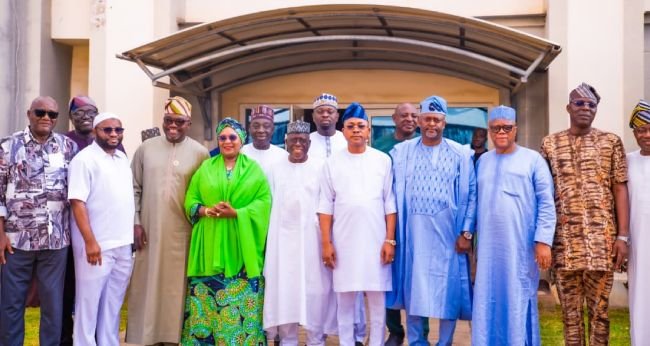

Kogi State Governor Ahmed Usman Ododo has inaugurated a 17-member APC Peace and Conflict Resolution Committee to address internal disputes, reconcile aggrieved members and strengthen the All Progressives Congress (APC) ahead of the 2027 general elections.
Ododo inaugurated the committee on Tuesday, September 8, 2026, in Kogi State, with former governor Idris Ichala Wada appointed chairman. The governor tasked the panel with identifying the roots of party disputes, engaging affected members and developing practical solutions capable of restoring unity within the APC.
The move comes as political parties intensify preparations for the 2027 elections, with internal cohesion increasingly becoming a major factor in candidate mobilisation, grassroots organisation and electoral competitiveness.
The governor gave the newly inaugurated APC peace committee three weeks to complete its assignment and produce a series of reports and recommendations.
Its mandate includes:
- Mapping grievances and key stakeholders across Kogi State.
- Identifying unresolved internal disputes and proposing solutions.
- Reaching out to aggrieved party leaders and members.
- Developing a continuous reconciliation framework for the APC.
- Reintegrating returning members and accommodating new entrants.
- Producing recommendations for stronger grassroots mobilisation and party unity.
The committee is also expected to submit a final reconciliation and political harmonisation report outlining measures that could strengthen the party’s support base before the 2027 polls.
That deadline gives the panel a relatively short window to move beyond political consultations and produce recommendations that the party can implement.
Former Kogi State governor Idris Ichala Wada will lead the committee, alongside former deputy governors Yomi Awoniyi and Edward Onoja, who will serve as first and second vice chairmen respectively.
Pharm. Mohammed Jamiu Asuku was named third vice chairman, while Mohammed Suleiman will serve as secretary.
Other members include:
- Sani Teidi
- Ramatu Tijani Aliyu
- Salamatu Baiwa Umar-Eluma
- Dan Okolo
- Kolawole Mathew
- Abubakar Sanusi Gamji
- Abubakar Sadiq Amodu
- Ado Shuaibu
- Abdulkareem Salihu
- Ramatu Shehu Atta
- ASP Aurelus Adejoh Yusuf
- Bode Ogunmola.
The composition brings together former political office holders, party stakeholders and other figures the governor believes can help bridge divisions within the ruling party.
Ododo said reconciliation should be based on dialogue and consultation rather than confrontation.
He urged committee members to reach out to party members who feel marginalised, understand the issues behind their grievances and work towards mutually acceptable resolutions.
The governor also called for inactive founding members of the APC to be identified and encouraged to return to the party.
His broader argument is that the APC’s electoral strength in Kogi will depend not only on its incumbency but also on its ability to keep competing interests within the party structure.
The governor further reaffirmed his support for President Bola Ahmed Tinubu and the APC’s national political agenda, citing federal projects and other support for Kogi State as reasons for continued alignment with the administration.
The reconciliation effort comes at a critical stage of the political cycle. Internal disagreements can affect a party’s ability to retain aspirants, mobilise supporters and coordinate campaigns once the election season intensifies.
Kogi has remained an important APC stronghold, with the party controlling the state government since 2016. Ododo is therefore seeking to turn organisational unity into an electoral advantage as the 2027 contest approaches.
The development also fits into a broader pattern across Nigerian political parties, where reconciliation panels have increasingly been used to manage disputes following primaries and other internal contests. In July, for example, the APC’s Oyo chapter established a reconciliation committee after grievances emerged from its primaries.
The ADC has similarly created a national reconciliation and peace committee following disagreements generated by its recent primaries, highlighting how internal party management has become a significant part of preparations for 2027.
The immediate challenge for the Kogi APC peace committee will be whether it can translate consultations into settlements that affected members accept.
A successful reconciliation process will require more than identifying grievances. It will also depend on whether the party adopts workable recommendations and gives previously dissatisfied members meaningful opportunities to participate in its political structure.
For the committee, the three-week deadline provides a clear timetable. Its eventual report could therefore offer an early indication of whether the Kogi APC can consolidate its internal structure before the full political contest for 2027 gathers momentum.
The inauguration also comes on the same day that 19 political parties in Kogi signed a peace accord ahead of the 2027 elections, pledging to conduct campaigns peacefully and within the law.
While that agreement addresses competition between political parties, Ododo’s committee focuses on divisions within the APC. Together, both developments underscore the growing emphasis on political stability and conflict management ahead of the 2027 electoral cycle.