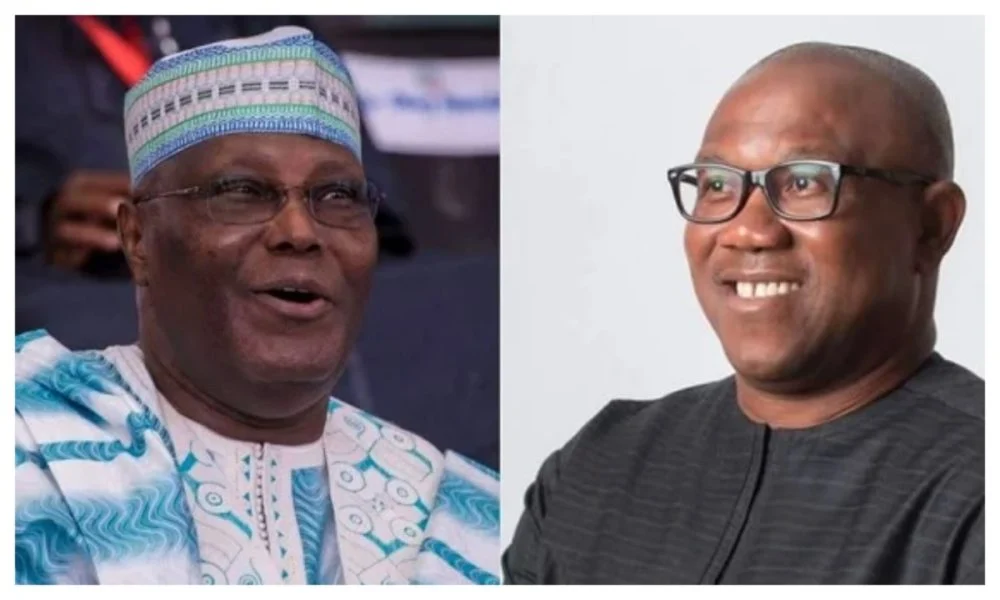

Former Vice President and African Democratic Congress (ADC) presidential candidate, Atiku Abubakar, has condemned the reported obstruction and attack on the convoy of Nigeria Democratic Congress (NDC) presidential candidate Peter Obi in Benue State.
Atiku, through his campaign spokesman, Kenneth Okonkwo, reacted on Wednesday, September 9, 2026, after Obi’s convoy was stopped by a group of youths while the former Anambra State governor was travelling towards Yelwata in the state.
Obi said he had travelled to Benue to sympathise with families affected by the deadly violence in Yelwata and insisted that the visit was humanitarian rather than a campaign activity.
Atiku described the incident as unacceptable and undemocratic and urged relevant authorities to investigate what happened, identify those responsible and ensure accountability.
The controversy has triggered competing claims. Obi’s camp alleged that suspected thugs deliberately blocked his convoy, while the Benue State Government denied involvement and said it had not been officially informed about his visit.
In his reaction, Atiku focused on the broader democratic implications of the confrontation.
The ADC presidential candidate argued that political disagreements should not result in violence or prevent political figures from moving freely within the country.
His spokesman said the authorities should urgently establish what happened and hold anyone found responsible accountable.
The call comes at a politically sensitive period, with major opposition figures already positioning themselves ahead of the 2027 presidential election.
Atiku and Obi are both prominent opposition figures, although they are currently running under different political platforms.
The incident has consequently attracted attention beyond the immediate dispute because it raises questions about political tolerance and the safety of opposition politicians during the build-up to the next general election.
Atiku’s position also places pressure on security agencies to provide a clear account of the incident, particularly because conflicting narratives have emerged over who organised the road blockade and why.
As of Wednesday, reports had not established independently that the youths were acting on behalf of any political actor.
Obi arrived in Benue on Tuesday as part of a planned visit to Yelwata, a community that suffered a deadly attack in 2025.
His convoy encountered a group of youths along the Makurdi-Gboko road near the Nigerian Air Force Base.
Videos circulated by members of Obi’s team appeared to show a crowd blocking the road as security personnel positioned themselves between the group and the convoy. Reports said the convoy eventually turned back.
Obi subsequently said he was not in Benue to campaign.
He explained that his intention was to meet people affected by the violence, express sympathy to bereaved families and listen to their experiences.
The NDC later condemned what it described as an attack and obstruction of its presidential candidate, alleging that a government-linked official was involved.
However, that allegation remains disputed.
The Benue State Government has rejected claims that it organised or supported the roadblock.
The Benue State Government has denied responsibility for the incident and accused Obi of failing to comply with established protocol for visiting the state.
Commissioner for Information and Culture, Solomon Lorpev, said on Wednesday that Governor Hyacinth Alia was not officially informed about Obi’s arrival.
The government has therefore rejected the suggestion that it deployed people to stop the NDC candidate.
It also challenged those making allegations against government officials to provide evidence.
The competing accounts mean that the circumstances surrounding the confrontation remain unresolved.
The major disputed issues include:
- Who organised the youths who blocked the road.
- Whether any political or government-linked individual directed the action.
- Whether Obi’s visit was formally communicated to the state government.
- Why the convoy was stopped despite the presence of security personnel.
- Whether criminal charges or other investigations will follow.
The police and other relevant security authorities will therefore be central to establishing an independent account of what occurred.
Obi’s intended destination, Yelwata, has become associated with one of the most devastating episodes of violence in Benue in recent years.
His proposed visit was intended to offer condolences to families affected by the killings and to engage communities dealing with the aftermath.
The confrontation is also not the first dispute involving Obi’s visits to Benue.
Premium Times reported that the latest incident marked the second reported disruption of a planned visit by Obi to the state after a previous disagreement in 2025. On that occasion, Governor Alia had raised security and protocol concerns.
That history has added another layer to the latest confrontation.
For supporters of Obi, the incident represents an unacceptable restriction on political movement. For the state government, the issue is one of protocol and the need to properly coordinate high-profile visits.
The difference between those positions is likely to keep the dispute in the political spotlight unless an independent investigation clarifies what happened.
The reaction from Atiku comes as Nigerian political parties intensify preparations for the 2027 elections.
The reported attack has raised concerns about whether political actors will be able to campaign, meet supporters and visit communities without intimidation as the election approaches.
Other political figures have also criticised the incident. Minister of Aviation and Aerospace Development Festus Keyamo described the blockade as inconsistent with democratic practice, while opposition figures demanded greater protection for political activities.
For security agencies, the immediate responsibility is to prevent further confrontation and determine whether any offences occurred.
For political parties, the episode presents another test of their commitment to peaceful competition.
The outcome of any investigation could also influence public perception of political tolerance in Benue and the wider country.
Atiku’s demand for an investigation puts accountability at the centre of the controversy surrounding Peter Obi’s Benue visit.
The key next step is for the relevant security authorities to establish the facts independently rather than allowing competing political claims to determine the narrative.
If individuals are found to have unlawfully obstructed or attacked the convoy, they could face appropriate legal consequences. Equally, allegations against government officials should be substantiated before responsibility is assigned.
The incident also underscores the importance of political actors maintaining open channels of communication when organising high-profile visits, particularly in areas affected by insecurity.
As Nigeria moves closer to the 2027 elections, the ability of opposition candidates and other political figures to travel, engage communities and campaign without intimidation will remain an important test of the country’s democratic environment.