
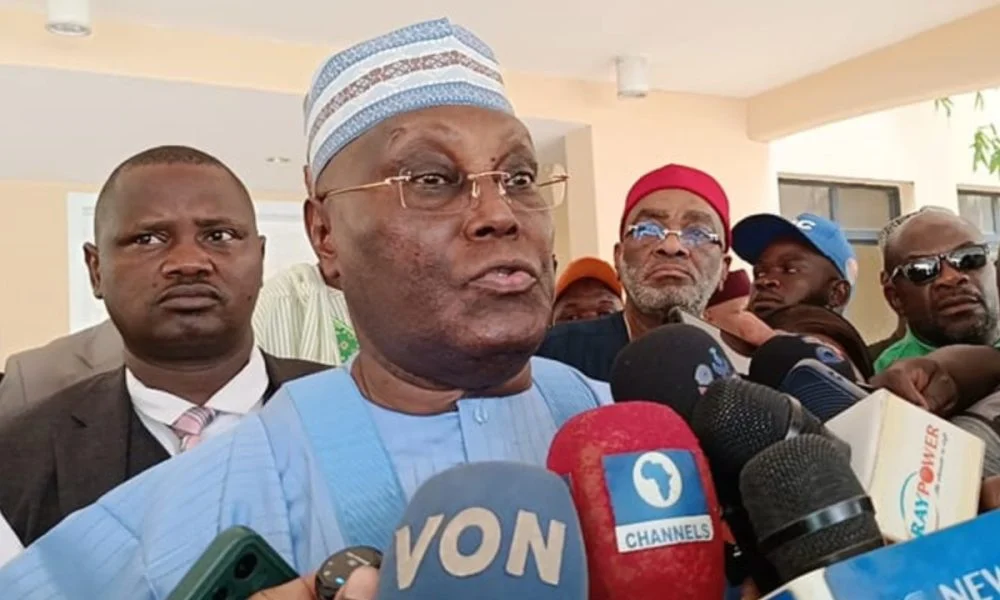

Former Vice President Atiku Abubakar has raised concerns over a ₦266.07 billion net outflow of foreign portfolio investment from Nigeria’s equities market, describing the development as a warning sign for investor confidence under President Bola Tinubu.
The figures, covering January to July 2026, show that foreign investors brought ₦513.36 billion into the Nigerian equities market during the seven-month period but withdrew ₦779.43 billion, leaving a net deficit of ₦266.07 billion. The data were released by the Nigerian Exchange (NGX) and cited in Atiku’s statement on September 8.
Atiku, through his Senior Special Assistant on Public Communication, Phrank Shaibu, argued that the figures should prompt closer scrutiny of the country’s economic policies and investment climate.
However, market analysts have offered a more nuanced interpretation, pointing to profit-taking, portfolio rebalancing, attractive fixed-income opportunities and broader macroeconomic concerns as factors that can influence foreign portfolio flows.
The NGX figures show that the negative balance was not concentrated in a single month.
Foreign investors recorded higher withdrawals than inflows in each month between January and July 2026, indicating sustained selling pressure rather than one isolated transaction.
The monthly pattern included:
- January: ₦47.86bn inflow against ₦66.28bn outflow.
- February: ₦66.71bn inflow against ₦72.32bn outflow.
- March: ₦107.05bn inflow against ₦181.77bn outflow.
- April: ₦90.84bn inflow against ₦156.94bn outflow.
- May: ₦87.60bn inflow against ₦96.01bn outflow.
- June: ₦71.71bn inflow against ₦115.08bn outflow.
- July: ₦41.59bn inflow against ₦91.03bn outflow.
March recorded the largest monthly deficit at ₦74.72 billion, while July posted the year’s weakest foreign inflow at ₦41.59 billion.
The scale of the 2026 outflow becomes clearer when compared with previous years.
NGX data show that the net foreign outflow for the first seven months increased from ₦22.68 billion in 2023 to ₦64.72 billion in 2024, before easing to ₦61.83 billion in 2025.
By July 2026, however, the figure had jumped to ₦266.07 billion. That represents more than four times the corresponding 2025 figure and about 11.7 times the 2023 level.
The three-year figures were:
| Period | Foreign inflows | Foreign outflows | Net position |
|---|---|---|---|
| Jan–Jul 2023 | ₦81.47bn | ₦104.15bn | -₦22.68bn |
| Jan–Jul 2024 | ₦266.64bn | ₦331.36bn | -₦64.72bn |
| Jan–Jul 2025 | ₦609.73bn | ₦671.56bn | -₦61.83bn |
| Jan–Jul 2026 | ₦513.36bn | ₦779.43bn | -₦266.07bn |
The figures suggest that the challenge is not simply attracting foreign money into Nigerian equities but retaining it once it enters the market.
Atiku has interpreted the figures as a negative assessment of the government’s economic management.
His camp argues that sustained foreign selling reflects concerns about the country’s economic direction and the conditions facing investors.
The former vice president also raised concerns about government borrowing and its potential effect on private-sector financing, arguing that increased public-sector demand for domestic funds could constrain businesses.
Those claims should be distinguished from the NGX data themselves. The exchange figures establish the size and direction of foreign portfolio flows; they do not, by themselves, establish that government policy was the sole reason investors sold Nigerian equities.
Market observers have identified several possible explanations for the foreign outflows.
Analysts cited by financial publications have pointed to:
- Profit-taking after gains in Nigerian equities.
- Portfolio rebalancing by international investors.
- The relative attractiveness of fixed-income investments.
- Concerns about Nigeria’s broader macroeconomic environment.
- Currency and repatriation considerations.
- Greater caution surrounding the country’s investment outlook.
Fiona Ahimie, President of the Chartered Institute of Stockbrokers, said the continued foreign selling was concerning because international investors had yet to demonstrate sufficient confidence in maintaining long-term positions in Nigerian equities.
Investment analyst Tajudeen Olayinka, however, noted that foreign investors had not necessarily abandoned Nigeria’s capital market altogether, with some potentially shifting allocations toward fixed-income securities where yields have remained attractive.
Despite the foreign outflow, activity on the Nigerian Exchange has remained robust.
Total NGX transactions reached approximately ₦11.98 trillion in the first seven months of 2026, almost double the ₦6.01 trillion recorded during the corresponding period of 2025. Much of that expansion was driven by domestic investors.
Foreign participation consequently represented a relatively small share of market activity.
Data reported for July put foreign participation at approximately 5.6%, leaving domestic investors responsible for the overwhelming majority of transactions during the month.
This creates an important distinction in assessing the health of the Nigerian stock market: high overall turnover does not necessarily mean foreign investor participation is improving.
Foreign portfolio investment can provide liquidity to domestic capital markets and create additional demand for Nigerian securities.
A persistent net outflow can therefore raise questions about:
- Foreign investor appetite for Nigerian assets.
- The depth and liquidity of the equities market.
- Foreign-exchange demand and capital repatriation.
- The ability of Nigerian companies to attract international portfolio capital.
- The country’s broader investment reputation.
At the same time, portfolio flows can change rapidly and should not automatically be treated as a direct measure of the entire economy. Investors can sell equities while continuing to hold Nigerian bonds or other assets.
The distinction is particularly relevant in 2026 because analysts have pointed to stronger yields in fixed-income markets as one reason some foreign capital may have shifted rather than completely exited Nigeria.
The latest figures put renewed attention on whether Nigeria can convert recent efforts to stabilise its macroeconomic environment into sustained foreign investment.
For the Tinubu administration, the challenge extends beyond attracting capital at the point of entry. Investors also need confidence that they can operate in a predictable regulatory environment, manage currency risks and achieve competitive returns.
For the opposition, the ₦266.07 billion outflow provides ammunition to question the government’s economic record.
But the investment data alone do not settle that political argument. The more significant question for policymakers is whether foreign investors continue to reduce their exposure to Nigerian equities in the months ahead and whether the trend extends beyond portfolio investments.
Nigeria recorded a ₦266.07 billion net foreign portfolio investment outflow from its equities market between January and July 2026, according to NGX data. The figure represents a sharp deterioration from the corresponding periods of 2023, 2024 and 2025.
Atiku Abubakar has described the development as evidence of declining confidence in President Bola Tinubu’s economic management. However, financial-market analysts have identified a combination of factors, including profit-taking, portfolio reallocation, attractive fixed-income yields and broader economic uncertainty.
The immediate issue for Nigeria is therefore not simply the size of the outflow, but whether policymakers can improve the conditions needed to retain international capital while sustaining the strong domestic participation that has supported activity on the NGX.