
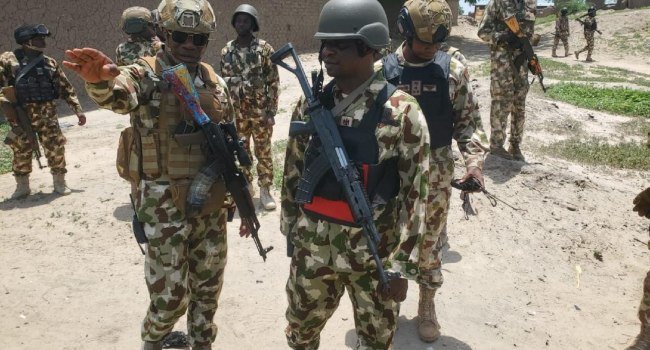

A Boko Haram/Islamic State West Africa Province (ISWAP) fighter has surrendered to Nigerian troops in Borno State, while soldiers separately arrested six suspected members of a kidnapping syndicate in Adamawa, the Army said on Monday, September 14, 2026.
The two developments occurred during separate operations conducted by troops of Operation Hadin Kai in the North-East. In Borno, troops received the surrender of the terrorist at Borgozo in Benisheikh, Kaga Local Government Area, on Sunday, while the Adamawa operation targeted suspected kidnappers operating around Soktu Hill in Song Local Government Area.
The Army said preliminary inquiries indicated that the surrendered fighter had left a terrorist enclave and intended to abandon the insurgency. Troops recovered an AK-47 rifle, 14 rounds of 7.62mm ammunition, four magazines, an improvised explosive device, a magazine pouch and a bicycle from him.
The developments underscore the military’s continued focus on both insurgent networks and criminal groups operating across the North-East.
Troops of 29 Task Force Brigade, operating under Sector 2 of Operation Hadin Kai and supported by Forest Guards, received the surrendering terrorist in Kaga Local Government Area.
According to the Army, the man is being held for further investigation and profiling. Authorities have not publicly identified him or provided details about his specific role within the Boko Haram/ISWAP network.
The recovered items included:
- One AK-47 rifle
- Four rifle magazines
- 14 rounds of 7.62mm ammunition
- One improvised explosive device
- One magazine pouch
- One bicycle
The recovery of the rifle, ammunition and IED means investigators will have an opportunity to examine the surrendered fighter’s alleged operational activities and possible links to other members of the group.
The latest surrender comes against the backdrop of sustained military pressure on terrorist groups in the North-East.
Recent military operations have produced a combination of arrests, weapons recoveries, rescues and terrorist surrenders. Earlier operational reports attributed some of the surrender activity to pressure on terrorist enclaves, shortages of food and supplies, insecurity and internal disputes among rival factions.
The military has therefore increasingly used surrender and intelligence exploitation alongside conventional combat operations as part of its campaign against Boko Haram and ISWAP.
However, a surrender does not by itself establish the extent of an individual’s involvement in terrorism. Each case requires screening, interrogation and appropriate legal processing.
In a separate operation in Adamawa State, troops of Sector 4 Operation Hadin Kai, working with local hunters, arrested six people suspected of belonging to a kidnapping syndicate.
The operation followed intelligence concerning the group’s activities around Soktu Hill in Song Local Government Area.
Troops initially raided an identified hideout and arrested three suspects, recovering one Dane gun. The Army said subsequent intelligence-led and covert operations resulted in the arrest of three additional suspects, taking the total number of arrests to six.
Investigators are now examining the alleged activities of the group and its possible connections to reported abductions in the area.
According to the Army’s preliminary findings, the suspected syndicate allegedly operated around Soktu, Dumne and Maigero areas of Song Local Government Area.
The suspects reportedly admitted involvement in the abduction of several victims for ransom as well as other violent offences. Those claims remain allegations until established through investigation and, where applicable, court proceedings.
The Adamawa arrests highlight the overlap between counter-insurgency operations and efforts to tackle organised kidnapping in communities affected by insecurity.
The military said the suspects remain in custody while investigators pursue further inquiries and prepare for appropriate legal action.
The latest operations show the broad range of security threats confronting communities across the North-East.
While Boko Haram and ISWAP remain major counter-terrorism targets, criminal kidnapping networks also pose a significant threat to residents, travellers and businesses.
Recent military reporting has documented operations against terrorist fighters, logistics suppliers, informants and kidnappers across Borno, Adamawa, Yobe and neighbouring areas. In August, the military reported 201 terrorist surrenders in the North-East alongside arrests and other operational gains.
The security challenge therefore extends beyond battlefield engagements. Intelligence gathering, community cooperation and disruption of criminal logistics remain important components of the campaign.
The surrendered terrorist and the six suspected kidnappers remain in military custody as investigations continue.
For the surrendered fighter, investigators are expected to establish his identity, role, affiliations and knowledge of terrorist networks before determining the appropriate next step.
For the Adamawa suspects, authorities will investigate the alleged kidnappings and other crimes attributed to the group and determine whether sufficient evidence exists for prosecution.
The Army has also stressed the importance of cooperation from local communities, whose information can help security agencies identify hideouts, criminal networks and movement patterns.
The latest operations demonstrate that security forces are pursuing two parallel objectives in the North-East: weakening established terrorist organisations through military pressure and disrupting criminal networks that exploit insecurity to carry out kidnappings and other violent crimes.