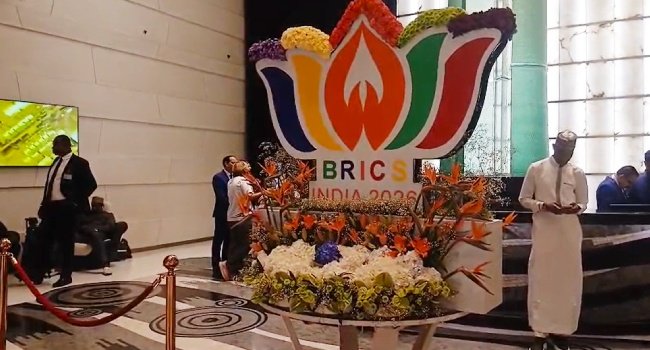

India is set to welcome world leaders and senior international officials for the BRICS Summit 2026, with the 18th BRICS Leaders’ Summit taking place at Bharat Mandapam in New Delhi on September 12 and 13 as Prime Minister Narendra Modi seeks to use India’s chairmanship to strengthen cooperation among emerging economies and advance the interests of the Global South.
Russian President Vladimir Putin has already arrived in the Indian capital, while Chinese President Xi Jinping and other heads of government are expected to join the gathering. The summit brings together the 11 BRICS member states and representatives of partner countries and international organisations for discussions on economic cooperation, global governance, technology, security and sustainable development.
India assumed the BRICS chairmanship on January 1, 2026, making this its fourth time leading the grouping after previous chairships in 2012, 2016 and 2021.
The BRICS Summit 2026 is being held under India’s theme, “Building for Resilience, Innovation, Cooperation and Sustainability.” New Delhi has used its chairmanship to push discussions around economic resilience, technological development, sustainable growth and stronger cooperation among developing economies.
The expanded grouping now includes:
- Brazil
- Russia
- India
- China
- South Africa
- Egypt
- Ethiopia
- Indonesia
- Iran
- Saudi Arabia
- United Arab Emirates
The bloc has also established a partner-country category, with countries including Nigeria, Belarus, Bolivia, Cuba, Kazakhstan, Malaysia, Thailand, Uganda, Uzbekistan and Vietnam participating as partners in 2026.
The expansion has significantly increased BRICS’ demographic and economic weight. The grouping collectively represents roughly 49 per cent of the world’s population and about 40 per cent of global GDP, according to Indian public broadcaster Akashvani.
The arrival of senior leaders has transformed New Delhi into the centre of high-level diplomacy ahead of the summit.
Putin arrived in the capital on Thursday night, while Xi is scheduled to arrive on Saturday. Other leaders expected to participate include South African President Cyril Ramaphosa, Egyptian President Abdel Fattah el-Sisi, Indonesian President Prabowo Subianto and Iranian President Masoud Pezeshkian.
Abu Dhabi Crown Prince Sheikh Khaled bin Mohamed bin Zayed Al Nahyan and Ethiopian Prime Minister Abiy Ahmed are also expected to attend.
Brazil will be represented by Foreign Affairs Minister Mauro Vieira, while Saudi Arabia’s Foreign Minister Prince Faisal bin Farhan Al Saud is expected to participate on behalf of Riyadh.
The wider gathering also includes Malaysian Prime Minister Anwar Ibrahim and Vietnamese Prime Minister Le Minh Hung, alongside United Nations Secretary-General António Guterres, World Health Organisation Director-General Tedros Adhanom Ghebreyesus and New Development Bank President Dilma Rousseff.
Although economic cooperation remains central to BRICS, the 2026 summit comes at a time of significant geopolitical uncertainty.
Leaders are expected to consider ways to strengthen the group’s role in global governance while addressing challenges affecting international trade, investment, energy, technology and security.
The agenda also reflects BRICS’ broader ambition to give developing economies a stronger voice in international institutions.
The group’s previous declarations have repeatedly called for greater representation of developing countries in institutions including the United Nations Security Council and the International Monetary Fund.
India’s presidency has also emphasised innovation and digital cooperation, including efforts to improve collaboration in areas such as artificial intelligence, digital public infrastructure and emerging technologies.
For New Delhi, the summit provides an opportunity to demonstrate that an expanded BRICS can remain effective despite differences among its members over foreign policy and geopolitical priorities.
The arrival of international delegations has prompted extensive security and logistical preparations across the Indian capital.
Authorities have introduced traffic restrictions and diversions around key routes as convoys carrying foreign leaders and other delegates move through the city. Schools and government offices in Delhi were also ordered to close on September 11 to facilitate arrangements for the high-profile event.
New Delhi has also undergone a major beautification exercise ahead of the summit, particularly along routes linking the airport, major hotels and Bharat Mandapam.
Authorities upgraded 17 roundabouts and added about 15,000 plants as part of preparations for the arrival of foreign delegations.
The measures underline the scale of the event, which is expected to bring together leaders and representatives from around 30 BRICS members and partner countries, international organisations and the business community.
The BRICS Summit 2026 gives India an opportunity to shape the direction of an increasingly expanded bloc while attempting to maintain consensus among countries with different economic systems and foreign-policy interests.
The New Delhi meeting is also significant because BRICS has evolved considerably since its first summit in Yekaterinburg in 2009. What began as BRIC, comprising Brazil, Russia, India and China, added South Africa in 2011 and underwent another major expansion in 2024.
The immediate challenge for India will be turning the bloc’s growing size into practical cooperation. Progress on trade, finance, technology, sustainable development and institutional reform could determine whether the expanded BRICS becomes a more influential force in global affairs.
With the summit beginning Saturday, attention will now shift from arrivals and preparations to the negotiations, bilateral meetings and commitments that emerge from the leaders’ discussions.