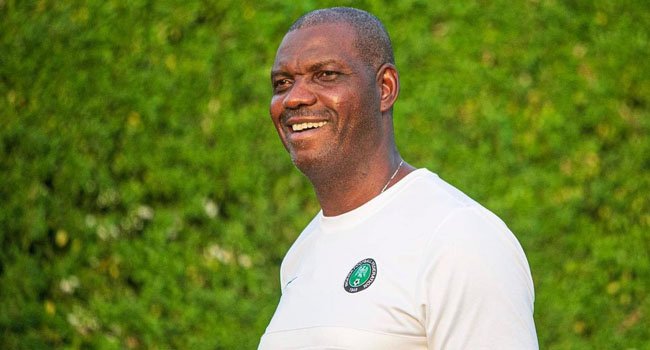

Augustine Eguavoen has been handed temporary charge of the Super Falcons as Nigeria prepares for a crucial two-leg second-round tie against Comoros in the 2028 Olympic Games qualifiers.
The Nigeria Football Federation (NFF) confirmed the appointment on Tuesday, September 8, 2026, with Eguavoen set to lead the senior women’s national team while the federation continues its search for a permanent head coach.
The appointment comes at a critical moment for the Super Falcons following a difficult period for Nigerian women’s football. The team missed qualification for the 2027 FIFA Women’s World Cup, ending Nigeria’s record of appearing at every edition of the tournament since its inception in 1991.
Eguavoen’s immediate task is to steady the team and guide the 10-time African champions through their opening Olympic qualifying challenge against Comoros.
The former Super Eagles coach will take charge of the Super Falcons for both legs of the second-round Olympic qualifying tie.
According to the NFF, the matches are scheduled for October 9 and 13, 2026, with both fixtures to be played at Remo Stars Stadium in Ikenne-Remo.
Nigeria entered the second round automatically after receiving a bye as one of the three highest-ranked teams in the qualifying competition.
Comoros, meanwhile, secured its place in the round after an emphatic 30-0 aggregate victory over Sudan.
That disparity on paper will make Nigeria the clear favourite, but Eguavoen’s appointment comes with little room for experimentation. The Super Falcons must progress through multiple knockout stages to secure one of only two African places available for the women’s football tournament at Los Angeles 2028.
The immediate objectives for Eguavoen are therefore straightforward:
- Prepare the squad for the Comoros double-header.
- Restore confidence following recent setbacks.
- Build continuity within the technical setup.
- Secure progression to the third qualifying round.
Eguavoen will not work alone.
The NFF has appointed Christopher Danjuma, head coach of Nigeria Women’s Football League club Nasarawa Amazons, as his assistant.
Danjuma brings considerable experience from Nigeria’s women’s national teams. He previously coached the Falconets at the 2024 FIFA Under-20 Women’s World Cup in Costa Rica.
Former Super Eagles goalkeeper trainer Olatunji Baruwa has also been included in the interim setup as goalkeeper trainer.
Baruwa has worked with several Nigerian national teams, giving the temporary technical crew experience across both men’s and youth international football.
Former Super Falcons defender Ayisat Yusuf completes the coaching group as an assistant.
Yusuf made 68 appearances for Nigeria and represented the country at four Women’s Africa Cup of Nations tournaments, three FIFA Women’s World Cups and the 2008 Olympic Games in Beijing.
The appointment represents a new type of national-team assignment for Eguavoen, whose coaching career has largely centred on men’s football.
He previously managed the Super Eagles and led Nigeria to a bronze medal at the 2006 Africa Cup of Nations in Egypt. He has also served in senior technical roles within the national-team structure.
His temporary move to the Super Falcons comes as the NFF searches for a substantive coach.
The federation has not indicated that Eguavoen’s appointment is permanent, meaning his immediate performance in the Olympic qualifiers is unlikely to automatically determine who eventually gets the full-time position.
That arrangement gives the NFF time to conduct its search while ensuring the team has an established coaching structure ahead of the October fixtures.
Winning the Comoros tie would only be the beginning for the Super Falcons.
The African qualifying tournament consists of four rounds of two-legged knockout matches, with only two teams ultimately earning Olympic berths.
Nigeria’s potential route includes:
- Second round: Comoros — October 9 and 13, 2026.
- Third round: Democratic Republic of Congo or Morocco — February 23 to March 6, 2027.
- Fourth round: Potential opponents include Tunisia, Senegal, Benin Republic or Mali — October 4 to 12, 2027.
- Final round: Potential opponents include Guinea, Cameroon, DR Congo, Côte d’Ivoire, Central African Republic, Algeria or Burkina Faso — November 23 to December 4, 2027.
The difficult path means Nigeria cannot afford another prolonged period of uncertainty around the national team’s coaching structure.
For the Super Falcons, the Olympic campaign provides an opportunity to respond after a turbulent 2026.
Nigeria’s failure to reach the 2027 Women’s World Cup generated widespread criticism and contributed to significant changes within the country’s football administration. NFF president Ibrahim Gusau and general secretary Mohammed Sanusi resigned in August amid mounting pressure over the performances of the national teams.
The federation has since faced the task of rebuilding confidence around Nigeria’s national teams.
Eguavoen’s appointment is therefore about more than filling a temporary coaching vacancy. His first assignment will test whether an experienced national-team coach can quickly stabilise the Super Falcons and put their Olympic campaign back on track.
Eguavoen and his assistants now have a short preparation window before Nigeria faces Comoros in October.
The Super Falcons are expected to assemble ahead of the two matches, with progression to the third round the immediate target.
For the NFF, the longer-term challenge remains finding a permanent coach capable of rebuilding the team and restoring Nigeria’s position among the world’s leading women’s football nations.
For Eguavoen, the assignment offers a chance to add a new chapter to his international coaching career — this time with Nigeria’s most successful senior women’s national team.