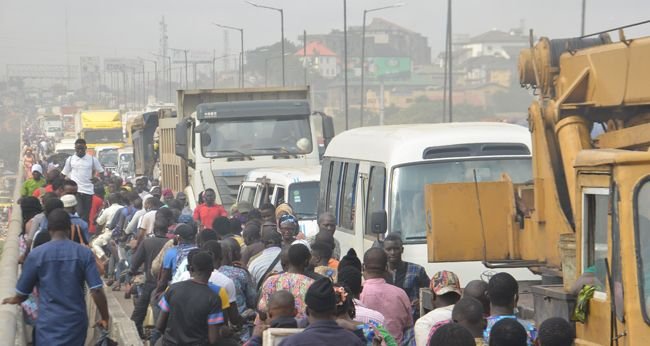

Motorists using the Lagos-Ibadan Expressway have faced severe delays since the Federal Government began repairs on the Kara-Berger Bridge, with traffic stretching from the bridge area in Ogun State towards major sections of Lagos on Tuesday and continuing into Wednesday morning.
The disruption followed the commencement of a two-week project to replace deteriorating expansion joints on the bridge. The Federal Ministry of Works scheduled the intervention from September 8 to September 22, 2026, as part of efforts to improve road safety and protect the structure from further deterioration.
The repair has nevertheless created an immediate challenge for commuters along one of the country’s busiest transport corridors. By Tuesday afternoon, queues had extended beyond the Secretariat Bus Stop, while motorists approaching the Otedola underpass from Ikeja and Agege also encountered heavy congestion.
The situation has raised renewed concerns about how major infrastructure repairs are managed on roads where there are limited alternatives for motorists.
The worst congestion emerged after work began on the bridge on Tuesday, with motorists reporting prolonged delays on journeys towards Mowe and Ibadan.
Traffic was particularly heavy around the Kara and 7Up areas, with the congestion extending into adjoining routes. The situation also affected motorists approaching the Otedola underpass and parts of the corridor connecting Ikeja and Agege to the expressway.
Traffic control personnel were deployed to keep vehicles moving through the restricted section. Police and military personnel worked alongside officials from the Lagos State Traffic Management Authority, Federal Road Safety Corps and Ogun State Traffic Compliance and Enforcement Corps.
Authorities alternated traffic from different directions in an effort to prevent the corridor from becoming completely blocked.
Despite the deployment, the volume of vehicles and restrictions around the construction area created substantial delays.
By Wednesday morning, motorists were still experiencing difficult conditions, with reports of vehicles using controlled one-way movement to navigate parts of the affected corridor.
Why the Kara Bridge is being repaired
The Federal Government says the intervention is necessary because the bridge’s expansion joints have deteriorated after prolonged use.
Expansion joints allow sections of a bridge to accommodate movement caused by changes in temperature and other structural forces. Engineers consider their proper functioning important to the long-term performance and safety of bridge infrastructure.
Federal officials previously warned that leaving the damaged joints unattended could increase the risk of structural problems, including cracking and buckling. The affected construction area covers roughly 100 metres and the work is being carried out in phases.
The government therefore faces a difficult balance: keeping traffic moving while carrying out repairs that authorities consider necessary for the safety of motorists.
The traffic disruption was not entirely unexpected.
Before work began, traffic authorities issued advisories warning motorists to anticipate restrictions and allow additional time for journeys through the Kara-Berger section.
The Lagos State Government said the affected carriageway would be handled in phases, with one half closed for construction while traffic uses the available section under controlled movement.
Ogun State traffic authorities also urged motorists whose journeys were not essential along the corridor to consider staying away during the rehabilitation period.
Motorists who must use the route have been advised to:
- Allow significantly more time for their journeys.
- Follow instructions from traffic-management officials.
- Avoid unnecessary trips through the affected section.
- Consider alternative routes where practical.
- Exercise caution around the construction area.
The challenge, however, is that the Lagos-Ibadan Expressway serves commuters, commercial transport operators and freight traffic moving between Lagos and communities in Ogun State and beyond.
For many road users, the immediate concern is not whether the bridge requires rehabilitation but how the work can be completed without bringing a major transport corridor close to a standstill.
Some motorists caught in the congestion expressed frustration over the time spent on the road and the limited alternatives available to people travelling towards Mowe and other communities along the expressway.
The complaints have also revived wider concerns about traffic management during infrastructure projects.
The Federal Government had initially planned the intervention for an earlier period but postponed commencement following concerns surrounding traffic management and public reaction to the proposed arrangement. The project eventually began on September 8.
For commuters, the key issue now is whether traffic authorities can improve the flow sufficiently to prevent the congestion from becoming a daily occurrence throughout the repair period.
Officials have previously advised motorists travelling towards Ibadan to consider alternative corridors where possible.
Potential options include routes around:
- Ikorodu and Ogijo;
- Shimawa;
- Sango;
- Abeokuta and adjoining roads.
However, the suitability of each alternative depends on the motorist’s destination, vehicle type and prevailing traffic conditions. The alternatives may also become congested if large numbers of motorists abandon the Lagos-Ibadan Expressway simultaneously.
That makes effective traffic coordination particularly important during the two-week intervention.
The current repair programme is scheduled to run until September 22, subject to construction and operational conditions.
The Federal Government says the objective is to address the deteriorating expansion joints, strengthen road safety and protect the long-term integrity of the Kara-Berger Bridge.
For motorists, however, the success of the project will be judged not only by whether the damaged joints are replaced but also by how effectively traffic is managed during the intervention.
The Lagos-Ibadan Expressway is a critical economic corridor linking Lagos with Ogun State and the wider South-West. Extended disruption can affect workers, businesses, commercial transport operators and the movement of goods.
As the repairs continue, authorities will need to maintain clear communication, strengthen traffic control and ensure that the work progresses according to schedule. If completed on time, the intervention should remove a known infrastructure risk; until then, motorists face a difficult period of congestion along one of Nigeria’s most heavily used highways.