
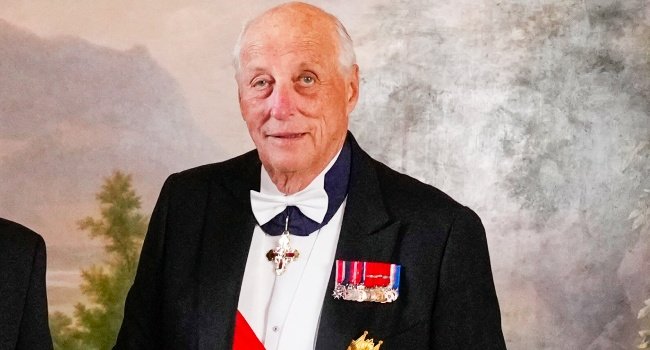

Norway’s King Harald V has died at the age of 89, ending a reign of more than 35 years and setting in motion the succession of his son, Crown Prince Haakon. The Norwegian Royal Court announced on Friday, August 28, that the king died peacefully at Oslo University Hospital in Oslo at 6:35 a.m. local time.
Harald had been receiving treatment in hospital since August 17 after medical examinations led to his admission. The palace had earlier said he was being treated for a bacterial infection in his bloodstream, while other reports said he had also been receiving treatment for a blood disorder.
The king was Norway’s ceremonial head of state and, before his death, Europe’s oldest living monarch. His passing marks the end of an era for a royal figure who spent more than three decades modernising Norway’s monarchy while maintaining a strong personal connection with the public.
The Royal Palace lowered its flag to half-mast following the announcement, while Norwegians gathered outside the palace in Oslo to leave flowers and pay their respects.
King Harald had experienced several health difficulties in recent years, leading him to reduce his official workload while remaining firmly opposed to abdication.
His health problems included infections and heart-related complications. In 2024, he was hospitalised while on holiday in Malaysia and received a temporary pacemaker before returning to Norway, where a permanent device was later fitted.
In August 2026, his condition deteriorated after he developed a bacterial infection in his bloodstream. The palace said doctors had been treating the infection with antibiotics before his death.
Harald had previously made clear that he intended to remain king for life. Rather than following the example of monarchs who have voluntarily stepped aside, he maintained that his commitment to the Norwegian throne was lifelong.
His decision became particularly significant as his son increasingly assumed responsibilities on behalf of the royal family during periods when the king was unable to carry out official duties.
Key facts about King Harald V
- Born: February 21, 1937
- Died: August 28, 2026
- Age: 89
- Became king: January 17, 1991
- Reign: More than 35 years
- Successor: Crown Prince Haakon
- Wife: Queen Sonja
- Role: King and ceremonial head of state of Norway
Harald became king following the death of his father, King Olav V, in 1991. He inherited a monarchy that had already enjoyed considerable public support but gradually introduced a more contemporary approach to the institution.
One of the defining features of Harald’s reign was his willingness to embrace changes in Norwegian society.
His own marriage to Sonja Haraldsen, a commoner, had already challenged traditional royal expectations. The couple married in 1968 after a lengthy period during which Harald had resisted pressure to abandon the relationship.
As king, he also became known for messages emphasising equality, tolerance and national unity.
Harald’s background was unusual for a modern European monarch. He was born in Norway in 1937, making him the first Norwegian-born heir to the throne in several centuries. During the Second World War, he spent part of his childhood abroad after Nazi Germany invaded Norway.
He later developed a reputation as an enthusiastic sailor and competed for Norway at three Olympic Games.
Beyond ceremonial duties, King Harald often played an important public role when Norway experienced national tragedy.
Following the 2011 terrorist attacks that killed 77 people, Harald delivered an emotional address that resonated widely across the country. His public appearances during periods of mourning reinforced his reputation as a figure associated with national unity rather than political power.
He also spoke publicly about Norway’s multicultural society and the importance of tolerance.
That approach helped distinguish Harald from more traditional models of European monarchy. Rather than presenting the royal institution as distant from ordinary citizens, he frequently sought to portray the monarchy as part of the wider Norwegian community.
His popularity remained relatively strong even as the Norwegian royal family faced increasing scrutiny in the final years of his reign. Reuters reported that Harald continued to receive high personal approval in public polling despite declining support for the monarchy as an institution.
King Harald’s death immediately triggered a historic transition within the Norwegian royal family.
His son, Crown Prince Haakon, 53, has succeeded him as monarch. Reuters reported that Haakon ascended the throne following his father’s death, with the new king expected to take the name Haakon VIII.
The transition comes as the royal family faces a challenging period.
Crown Princess Mette-Marit, Haakon’s wife, has faced intense public scrutiny over her past association with Jeffrey Epstein. Her son, Marius Borg Høiby, has also faced major legal controversy after being convicted of rape and domestic violence-related offences.
Those developments have placed additional pressure on a monarchy that has traditionally enjoyed strong public support.
What changes under the new reign?
- Crown Prince Haakon becomes Norway’s new monarch.
- Princess Ingrid Alexandra becomes the heir apparent.
- The government and parliament will formally recognise the succession.
- Haakon must take the constitutional oath before parliament.
- Norway does not hold a traditional coronation ceremony for its monarch.
Harald V leaves behind more than three decades of service to Norway and a monarchy that changed significantly during his reign.
His tenure covered major shifts in Norwegian society, technological change, international crises and moments of national tragedy. He also maintained a highly visible commitment to environmental issues and sport outside his constitutional responsibilities.
His death now places the Norwegian monarchy under new leadership at a particularly sensitive moment.
For Haakon, the challenge will be to preserve the public trust his father cultivated while guiding the institution through controversies surrounding other members of the royal family.
King Harald’s reign therefore ends not simply with the death of an 89-year-old monarch, but with a significant transition for one of Europe’s most established constitutional monarchies.