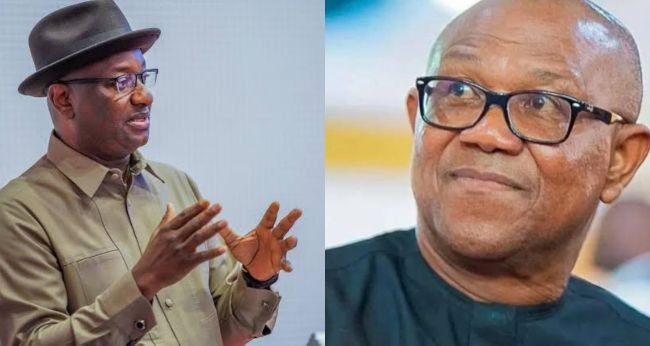

Minister of Aviation and Aerospace Development, Festus Keyamo, has condemned the obstruction of Nigeria Democratic Congress (NDC) presidential candidate Peter Obi during his visit to Benue State, describing the incident as unacceptable regardless of who was behind it.
Obi’s convoy was stopped by youths along the Makurdi-Gboko federal highway on Tuesday, September 8, 2026, while he was travelling to Yelwata in Guma Local Government Area to meet families affected by the deadly 2025 attack in the community.
The confrontation disrupted traffic and prevented Obi from reaching his intended destination. The NDC accused suspected political thugs of blocking the former Anambra State governor, while the Benue State Government denied involvement and suggested the incident could have arisen from internal political disagreements within the party.
Keyamo intervened in the controversy on Wednesday, saying that neither political disagreements nor allegations about Obi’s motives could justify preventing a presidential candidate from moving freely.
In his reaction, Keyamo said the circumstances surrounding the incident should not determine whether the obstruction was condemned.
He acknowledged competing claims about the motivation of the protesters, including the Benue Government’s suggestion that the dispute could be linked to internal disagreements within the NDC and allegations that rival political interests may have been involved.
The minister nevertheless argued that the fundamental issue was freedom of movement and the right of political actors to campaign without intimidation.
Keyamo also addressed claims that Obi’s planned trip to Yelwata was politically motivated because the killings occurred more than a year ago. He said even such criticism could not justify preventing the opposition candidate from visiting the community.
The minister’s position places the controversy within a wider question about how political campaigns will be conducted as Nigeria approaches the 2027 general elections.
The Benue State Government has firmly rejected allegations that it sponsored or organised the youths who blocked Obi’s convoy.
Governor Hyacinth Alia’s Chief Press Secretary, Tersoo Kula, said the state administration had no knowledge of the alleged action and denied deploying thugs as instruments of governance or security.
The government also questioned whether Obi’s visit had been properly communicated to relevant authorities ahead of time. It argued that a visit by a major presidential candidate would ordinarily require coordination with security agencies to ensure adequate protection.
The conflicting accounts have left several aspects of the incident unresolved.
- Obi and the NDC: Say his convoy was deliberately obstructed by suspected political thugs.
- Benue Government: Denies involvement and questions the notification and security arrangements for the visit.
- Police: Confirmed that Obi’s movement had security arrangements and said the circumstances surrounding the blockade were being investigated.
The competing claims underscore the need for an impartial investigation rather than political assumptions about who organised the roadblock.
The Benue State Police Command confirmed that officers had been assigned to provide security for Obi’s movement to Yelwata.
The command said the visit had been presented as an opportunity for Obi to visit people affected by the 2025 attack and commiserate with victims rather than as a conventional campaign event.
Police officials said the circumstances surrounding the blockade were being investigated, creating a potential avenue for determining who organised the protesters and why the road was blocked.
The NDC has separately called on the state government and security agencies to investigate the incident, identify those responsible and ensure that political figures and ordinary citizens can move safely within the state.
Beyond condemning the blockade, Keyamo turned his attention to how political confrontations are reported in the media.
The minister accused sections of the Nigerian press of applying different descriptions to similar incidents depending on whether the affected politician belongs to the ruling party or the opposition.
He argued that confrontations involving governing-party politicians can sometimes be presented as evidence of public rejection, while incidents involving opposition politicians may instead be framed as attacks by sponsored supporters.
Keyamo urged journalists to apply consistent standards when covering political violence, protests and confrontations involving candidates.
His intervention therefore goes beyond the Benue incident itself, raising questions about political reporting ahead of the 2027 elections, when tensions are expected to intensify among parties and their supporters.
The blockade has exposed an early challenge for Nigeria’s approaching election season: whether political disagreements can remain within democratic boundaries as campaigns become more competitive.
The incident is particularly significant because Obi was travelling to Yelwata, a community associated with one of the country’s major recent episodes of violence. His planned visit was presented by the NDC as an opportunity to sympathise with affected families and assess the situation in the community.
Regardless of the competing political claims, Keyamo’s central argument is that disagreements with candidates should be resolved through democratic participation rather than physical obstruction.
As the 2027 campaign season develops, the response of security agencies, political parties and state authorities to similar incidents will be critical to maintaining confidence in Nigeria’s electoral process.
The immediate priority remains establishing what happened in Benue, identifying those responsible for the roadblock and ensuring that political disagreements do not escalate into violence or restrictions on lawful movement.