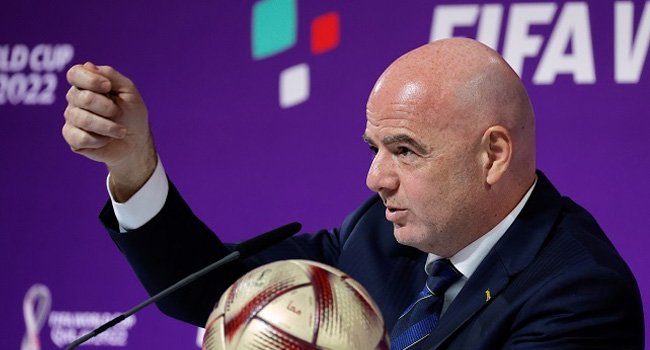

The dispute between the Asian Football Confederation (AFC) and the Qatar Football Association (QFA) escalated on Tuesday, August 18, 2026, after AFC President Sheikh Salman bin Ebrahim Al-Khalifa rejected Qatar’s challenge to his decision to join UEFA and CONCACAF in demanding accountability from FIFA President Gianni Infantino.
Sheikh Salman defended his authority to speak on issues he considers fundamental to Asian football, arguing that the AFC president has a responsibility to protect the interests and values of the sport. His response followed a complaint from QFA President Hamad bin Khalifa Al-Thani, who questioned why Qatar had not been consulted before the AFC joined the other confederations in criticising Infantino.
The confrontation has exposed a significant division inside Asian football at a critical point in the dispute over Infantino’s leadership and his bid for another term as FIFA president.
The immediate disagreement centres on an open letter issued jointly by UEFA, the AFC and CONCACAF criticising Infantino’s leadership and calling for him to leave office.
Qatar objected not necessarily because of the AFC’s position on FIFA governance, but because the QFA said it had not been consulted before the statement was issued in the name of the Asian confederation.
In a letter to Sheikh Salman, Hamad bin Khalifa Al-Thani argued that the AFC could not automatically assume that all 47 member associations shared the same position without first establishing a collective view. He also said Qatar had received no advance notice or opportunity to contribute to the statement.
That procedural objection has now become a wider political dispute within the Asian football structure.
Sheikh Salman rejected the allegation that he had exceeded his mandate.
The AFC president said his position was supported by the confederation’s constitution and that remaining silent on an issue he regarded as fundamental to Asian football would have conflicted with his responsibilities.
His response represents a firm rejection of Qatar’s interpretation of the AFC president’s role and signals that the disagreement is unlikely to disappear simply through internal consultation.
The dispute is particularly significant because the AFC represents 47 member associations and its position can carry considerable weight in FIFA politics.
The AFC-Qatar dispute is rooted in a broader crisis surrounding Gianni Infantino and FIFA.
Infantino has faced criticism over a proposal to create a new commercial structure around FIFA competitions and bring private investors into the organisation’s business.
The proposal involved selling a 20% stake linked to World Cup commercial rights with the aim of raising about $4.2 billion. Infantino subsequently abandoned the plan following widespread opposition.
UEFA, the AFC and CONCACAF have nevertheless continued to challenge FIFA’s leadership and governance approach.
The controversy has also emerged ahead of the 2027 FIFA presidential election, in which Infantino is seeking re-election.
The major fault lines currently include:
- FIFA’s proposed private investment structure.
- Concerns over transparency and consultation.
- The role of FIFA’s confederations in challenging the president.
- Infantino’s prospects of securing another term.
- Increasing divisions among national football associations.
Qatar’s position is particularly notable because it directly contrasts with the stance taken by the AFC leadership.
Earlier this month, Qatar joined five other Arab football associations in publicly supporting Infantino.
The statement was also backed by the football associations of Lebanon, Morocco, Sudan, Egypt and Mauritania. Four of the six signatories are members of the FIFA Council.
The six associations praised Infantino’s contribution to global football and expressed confidence in his leadership.
This places Qatar on the opposite side of the current FIFA governance dispute from its continental confederation.
Morocco, however, is not an AFC member; it belongs to the Confederation of African Football (CAF).
Sheikh Salman went beyond defending his authority, accusing the QFA of undermining unity within Asian football.
The AFC president pointed to previous occasions when Asian football leaders had issued collective positions on major issues, including support for Qatar’s successful bid to host the 2022 FIFA World Cup.
He questioned why Qatar had not previously raised procedural concerns about such practices and suggested that its current objection was selective.
The QFA had not immediately responded to a Reuters request for comment when the latest response was reported.
The exchange therefore leaves two competing interpretations of the AFC’s authority: Qatar insists that member associations should be consulted before the confederation claims to speak collectively, while Sheikh Salman maintains that the AFC leadership has a constitutional responsibility to act when major issues affect the continent’s interests.
The growing AFC-Qatar disagreement could have consequences beyond Asian football.
The AFC is one of FIFA’s six continental confederations, and its position matters in any contest over the organisation’s leadership.
Infantino continues to retain important support despite the backlash. Six Arab associations backed him this month, while CAF and the South American confederation have also remained supportive. At the same time, UEFA, the AFC and CONCACAF have challenged his leadership.
The result is an increasingly fragmented FIFA landscape ahead of the 2027 election.
For Qatar, maintaining its support for Infantino could strengthen its relationship with the FIFA leadership, but its confrontation with the AFC risks creating a deeper institutional divide within Asian football.
For Sheikh Salman, the dispute is a test of whether the AFC can maintain a unified position on global football governance while individual member associations pursue different political priorities.
The latest exchange shows that the FIFA leadership crisis has moved beyond a dispute between Infantino and his international critics.
It is now creating divisions within the football confederations themselves.
The AFC and Qatar remain part of the same continental structure, but their opposing positions on Infantino have exposed a fundamental disagreement over how the region should participate in global football governance.
With the 2027 FIFA presidential election approaching, further disagreements between national associations and their confederations could become increasingly consequential.
For now, Sheikh Salman’s response makes clear that the AFC does not intend to retreat from its criticism of Infantino, while Qatar has shown that it is prepared to challenge the continental body’s authority when its interests or principles differ.
The next stage of the dispute will likely depend on whether the AFC and QFA can reconcile their differences or whether the disagreement becomes part of a broader realignment of support ahead of the FIFA election.