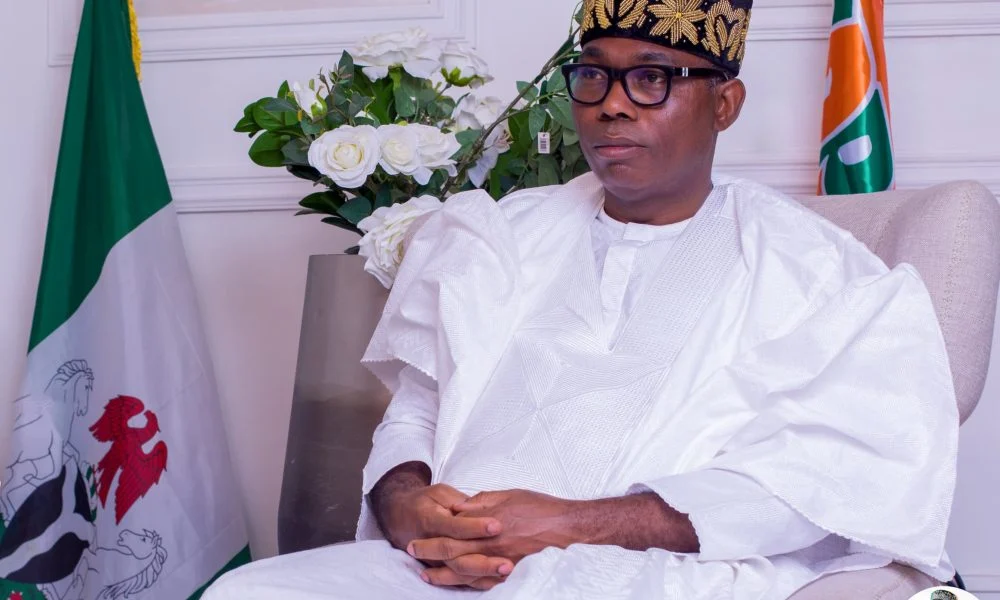

Social Democratic Party (SDP) presidential candidate Adewole Adebayo has urged Nigerians to vote President Bola Ahmed Tinubu and the ruling All Progressives Congress (APC) out of office in the 2027 general election, arguing that citizens cannot afford another four years under the current administration.
Adebayo made the call during an appearance on Channels Television’s Politics Today on Tuesday, September 8, 2026, where he rejected the perception that Tinubu and the APC are politically unbeatable.
The SDP candidate argued that Nigerian voters retain the power to determine the outcome of the presidential election and urged them to prioritise their economic and security interests when casting their ballots.
His remarks came as political parties intensified preparations for the 2027 election and shortly after the SDP unveiled its 2027–2031 policy document, titled “Farewell to Poverty and Insecurity.”
Adebayo’s latest intervention places the SDP’s campaign directly against the ruling party while seeking to present his candidacy as an alternative to the established political order.
A central part of Adebayo’s argument is that the APC’s incumbency does not guarantee victory in 2027.
He dismissed suggestions that Tinubu’s political machinery makes the president too difficult to defeat, saying the decisive factor would ultimately be the choices made by voters.
Adebayo argued that citizens should not allow financial inducements or short-term political benefits to determine their votes.
He maintained that a coordinated electorate could produce a result different from what the ruling party expects and predicted that the APC could perform poorly at the polls.
His argument rests on several factors:
- Voter participation: Adebayo says citizens must actively participate in the election.
- Economic concerns: He points to poverty and the pressure on household incomes.
- Security: Insecurity remains a central issue in his campaign.
- Political choice: He wants voters to consider alternatives outside the APC.
- Accountability: He argues that incumbency should not shield a government from electoral judgment.
Adebayo has made a similar appeal previously, warning Nigerians against boycotting the 2027 election and arguing that abstention could ultimately benefit the ruling party.
Adebayo’s criticism of the APC is closely connected to the SDP’s emerging policy message for the 2027 election.
At the unveiling of the party’s manifesto in Abuja, he challenged Tinubu to a public debate and said four years was sufficient for a determined government to make substantial progress in Nigeria.
The SDP’s policy document places poverty and insecurity among the major challenges it intends to address if elected.
Adebayo has promised that an SDP government would make security a major priority and said it would seek to tackle the country’s security crisis within its first term.
The candidate has also proposed significant changes in other sectors, including energy and agriculture. His recent campaign pledges include a plan to expand solar power nationwide and a promise to reduce petrol and other fuel prices if elected.
The combination of opposition to the APC and detailed policy proposals is intended to give the SDP campaign a message beyond simply criticising the incumbent.
The SDP candidate has increasingly framed the 2027 contest as a choice between continuing with the current administration and adopting an alternative policy direction.
His challenge to Tinubu for a public debate adds another dimension to that strategy.
Adebayo argues that Nigerians should assess presidential candidates based on their programmes rather than assuming that the incumbent has an automatic electoral advantage.
The debate challenge also comes as opposition parties continue to explore different strategies for confronting the APC in 2027.
While several political groups have discussed cooperation against the ruling party, Adebayo has previously indicated that the SDP would only participate in any broader arrangement if it serves what he considers the interests of Nigerians.
This leaves the SDP with the task of building its own electoral structure while competing in an increasingly crowded opposition space.
Adebayo’s call for voters to reject Tinubu and the APC adds to the growing political pressure surrounding the president’s re-election bid.
However, campaign rhetoric alone will not determine the outcome. The election will ultimately depend on voter turnout, party organisation, candidate popularity, campaign financing, coalition-building and the credibility of the electoral process.
For the SDP, the challenge is particularly significant. Adebayo contested the 2023 presidential election on the party’s platform and is now seeking to expand its national relevance ahead of another presidential contest.
The party must therefore convert its policy proposals and criticism of the APC into sufficient nationwide voter support.
For Tinubu and the APC, the opposition’s growing campaign means defending the administration’s record will become increasingly important as the 2027 contest moves closer.
Adebayo’s latest message is ultimately an appeal for Nigerians to use the ballot box to determine whether the APC remains in power after 2027.
His campaign is positioning poverty, insecurity, electricity, fuel prices, agriculture and governance as issues voters should consider when evaluating the competing parties.
Whether that message resonates widely will depend on how voters assess the Tinubu administration’s record against the alternatives presented by the SDP and other opposition parties.
With political campaigns gathering momentum, Adebayo’s direct call to vote out Tinubu signals that the SDP intends to make the incumbent’s record a central issue in its presidential campaign.
The 2027 election, however, remains months away, leaving substantial room for alliances, policy adjustments and shifts in voter sentiment before Nigerians ultimately cast their ballots.