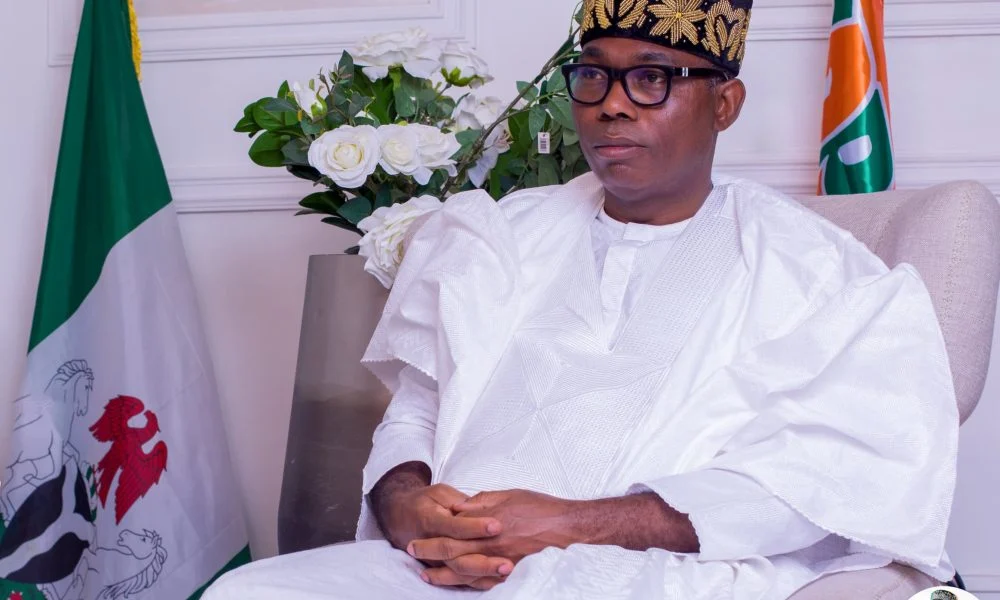

Social Democratic Party (SDP) presidential candidate Adewole Adebayo has promised to deploy between 11 and 15 kilowatts of solar power to every Nigerian roof within 11 months if elected president in the 2027 general election.
Adebayo made the pledge during an interview on Arise Television’s Prime Time on Tuesday, September 8, 2026, while outlining his proposed strategy for tackling Nigeria’s long-running electricity crisis.
Rather than relying primarily on expansion of the national grid, the SDP candidate proposed a decentralised energy system built around rooftop solar installations and community-based power clusters.
Under his proposal, Nigeria would establish solar-panel manufacturing facilities, train Nigerians to install and maintain renewable-energy systems and use decentralised generation to reduce pressure on the national grid.
Adebayo also projected that the proposed solar clusters could eventually produce as much as 32,000 megawatts, with the national grid serving largely as a backup when individual clusters experience disruptions.
The proposal comes as electricity supply remains a major economic and political issue ahead of the 2027 presidential election, with households and businesses continuing to depend heavily on alternative power sources.
Adebayo’s proposal combines local manufacturing with decentralised electricity generation.
The SDP candidate said factories would be established across Nigeria to manufacture solar panels, while partnerships with countries including China, Turkey and India could provide technical and industrial support.
He also proposed training Nigerians to operate, install and maintain the equipment.
According to Adebayo, the approach would serve two purposes: expanding access to electricity and creating employment through a domestic renewable-energy industry.
The central elements of the proposal include:
- 11–15kW of solar capacity targeted for every roof within 11 months of taking office.
- Local solar-panel manufacturing to reduce dependence on imported equipment.
- Training programmes for Nigerians involved in installation and maintenance.
- Decentralised solar clusters capable, according to Adebayo, of generating up to 32,000MW.
- The national grid as backup, rather than the country’s sole backbone for electricity supply.
- Job creation through manufacturing, installation and maintenance.
Adebayo said he had prior experience with solar technology and claimed to have trained approximately 2,000 people in his hometown. He also said he manufactures solar panels and lithium batteries but currently sources inverters from elsewhere.
The proposal represents a shift away from treating expansion of the national transmission and distribution network as the only route to wider electricity access.
Adebayo argued that decentralised solar systems could be particularly useful in communities where extending conventional power infrastructure is expensive or difficult.
He also questioned the continued use of costly conventional infrastructure for rural electrification, arguing that rooftop solar could deliver power closer to consumers.
The proposal is part of a wider policy platform in which Adebayo has advocated stronger government intervention in strategic sectors while maintaining a mixed economy.
His broader programme includes increased public investment in electricity, education, healthcare, manufacturing and other areas he believes can simultaneously improve services and generate employment.
The SDP candidate has also linked electricity reform to Nigeria’s wider energy-security problems.
Beyond solar energy, Adebayo said an SDP government would prioritise domestic crude-oil refining and intensify efforts to stop crude theft.
He argued that recovering crude currently lost through theft could increase the supply available for domestic refining without necessarily requiring equivalent additional government expenditure.
Adebayo has previously made crude theft a central part of his economic argument, maintaining that Nigeria loses significant resources that could otherwise support domestic energy production and economic growth.
His energy strategy therefore combines two distinct approaches:
- Expanding renewable electricity through decentralised solar generation.
- Strengthening conventional energy supply by improving crude production security and domestic refining.
The combination reflects Adebayo’s broader argument that Nigeria should exploit both its renewable-energy potential and existing oil resources while reducing waste and dependence on inefficient systems.
The scale and speed of Adebayo’s solar proposal make it one of the more ambitious electricity pledges emerging from the 2027 presidential campaign.
However, the practical implementation questions remain substantial.
A nationwide programme would require detailed answers on:
- The number of households and buildings that would qualify.
- The estimated cost of equipment, installation and maintenance.
- How batteries and inverters would be financed and replaced.
- The supply-chain capacity required to manufacture equipment domestically.
- How the programme would reach rural and underserved communities.
- The regulatory relationship between decentralised systems and existing electricity providers.
- How the proposed 32,000MW capacity would be integrated with the national electricity market.
Adebayo has outlined the broad architecture of his proposal, but the campaign would need to provide detailed financing, procurement, implementation and regulatory plans to demonstrate how the 11-month target could be achieved.
Adebayo’s pledge places electricity at the heart of his 2027 campaign message and gives the SDP a specific policy proposition on one of Nigeria’s most persistent economic problems.
His argument is that Nigerians should not have to wait for the national grid to expand before gaining reliable access to electricity.
Whether the proposal can move from campaign pledge to practical national programme will depend on its financing model, manufacturing capacity, technical workforce and implementation framework.
For now, Adebayo is presenting decentralised solar generation as the foundation of his proposed energy reform — with the ambitious objective of putting significant solar capacity on Nigerian roofs within his first 11 months in office.