
The Nigeria Customs Service (NCS) is reviewing ways to expand legitimate trade and improve revenue collection in Niger State, as officials engage businesses and other stakeholders over challenges affecting cross-border commerce and border operations.
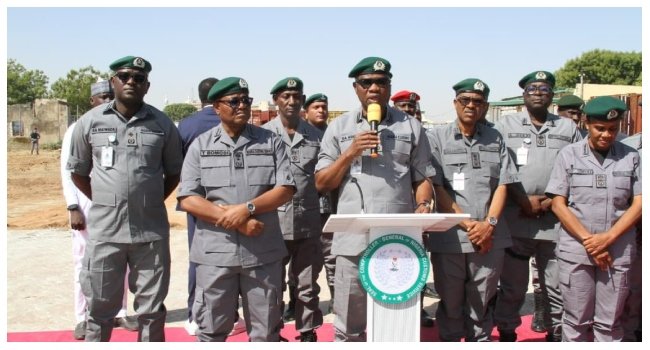
Assistant Comptroller-General Nsikak Umoh, the NCS Zonal Coordinator for Zone B, made the commitment on Wednesday, August 12, 2026, during a stakeholders’ engagement in Minna, the Niger State capital. The meeting formed part of the service’s wider consultation across the zone and focused on improving trade facilitation, tackling smuggling and strengthening revenue generation.
The discussions come as businesses operating around Niger State’s border communities continue to face challenges linked to border access and trading procedures.
Umoh’s visit to the Niger/Kogi Area Command was designed to assess operations and engage customs personnel on their readiness to deliver the service’s mandate.
He also met with businesses and other stakeholders to identify obstacles affecting legitimate commercial activities and cross-border movement.
According to the NCS, the discussions covered several areas:
- Procedures governing activities within the Free Trade Zone.
- Measures to combat smuggling.
- Challenges confronting businesses engaged in cross-border commerce.
- Improving cooperation between Customs and private-sector stakeholders.
- Increasing legitimate trade and government revenue.
The engagement reflects an attempt to balance two objectives that can sometimes come into conflict at border points: making legitimate commerce easier while maintaining controls against prohibited or undeclared goods.
For businesses operating in border communities, smoother procedures can reduce delays and transaction costs. For government, better compliance can broaden the number of transactions captured within the formal customs system.
One of the most significant demands raised during the engagement was the reopening of the Babanna border.
Stakeholders said the border has remained closed since 2018 and argued that the prolonged restriction has affected economic activity and legitimate commerce among communities on both sides.
They urged the NCS and other relevant authorities to reconsider the closure and develop a framework that would allow legitimate trade to resume without weakening border security.
The appeal places the Babanna crossing at the centre of the wider debate over how Nigeria manages its land borders.
For traders and communities, an accessible border can provide a formal route for moving goods and supporting local economies. For security agencies, however, reopening a border requires safeguards against smuggling and other illicit activities.
What stakeholders want
Their appeal centres on:
- Reconsideration of the Babanna border closure.
- Greater opportunities for legitimate cross-border trade.
- Measures to protect border security.
- Stronger cooperation between Customs and local businesses.
- Procedures that distinguish legitimate traders from smugglers.
The revenue performance of the Niger/Kogi Area Command was another major focus of the engagement.
Umoh commended the command after it substantially exceeded its revenue target. The command had a target of N17 million, but had generated approximately N200 million as of August 12, 2026, according to the NCS.
That represents revenue collection of more than 11 times the stated target.
The performance was cited by the zonal coordinator as evidence of the commitment of customs personnel to meeting the service’s revenue mandate.
Revenue figures at a glance
- Revenue target: N17 million
- Revenue generated: About N200 million
- Reported date: August 12, 2026
- Area Command: Niger/Kogi
- Supervising zone: NCS Zone B
The figures also illustrate why Customs is seeking to strengthen legitimate trade. Increased formal commercial activity can create additional opportunities for revenue collection while reducing the space for illicit trading networks.
The challenge for Customs extends beyond collecting more money.
Nigeria’s land borders play a crucial role in the movement of agricultural products, manufactured goods and other commodities. At the same time, border routes can be exploited to move restricted or undeclared goods into and out of the country.
The NCS therefore faces the task of improving trade facilitation without compromising enforcement.
The latest consultation provides an avenue for businesses to communicate operational difficulties directly to customs officials while allowing the agency to explain its regulatory requirements.
For Niger State, the issue is particularly important because of its strategic position and its border communities, where commercial activity is closely linked to movement across neighbouring territories.
A more efficient customs system could benefit both traders and government if legitimate transactions are brought into the formal economy.
The meeting in Minna is part of periodic consultations being conducted by the NCS across Zone B.
Rather than relying solely on enforcement at border points, the service is seeking greater engagement with businesses and other stakeholders to understand the practical challenges affecting trade.
That approach could help identify bottlenecks that discourage traders from using formal channels.
However, reopening a closed border or changing operating procedures would require decisions beyond the outcome of a single stakeholder meeting. Security considerations, existing government directives and the need to prevent smuggling would all have to be addressed.
For now, the NCS has indicated that it will continue examining measures that can support legitimate commerce while improving revenue collection and maintaining effective border controls.
The next test will be whether the consultations translate into concrete changes for traders and businesses in Niger State.
The NCS has an opportunity to use the feedback from stakeholders to simplify legitimate trade procedures, strengthen enforcement and improve the reliability of revenue collection.
The request to reopen Babanna will also require further consideration by the relevant authorities, particularly given the security implications of reopening a border that has been closed for several years.
With the Niger/Kogi Area Command already reporting revenue well above its target, Customs’ broader challenge is to determine how such performance can be sustained while creating an environment where legitimate cross-border trade can grow.
The outcome could have implications not only for government revenue but also for businesses and border communities whose livelihoods depend on formal commercial activity.