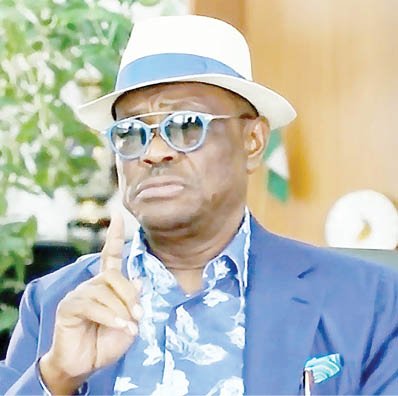

Minister of the Federal Capital Territory, Nyesom Wike, has said he expects to face political consequences if President Bola Tinubu loses the 2027 presidential election to opposition figures Atiku Abubakar or Peter Obi.
Wike made the declaration during a media chat in Port Harcourt, Rivers State, on Wednesday, September 2, 2026, while explaining why he has remained firmly committed to Tinubu’s re-election despite criticism of his political position.
The former Rivers State governor said his highly visible support for Tinubu had placed him among the politicians most likely to face retaliation if the opposition wins the presidency.
“I will be the first politician that I think they will come after,” Wike said, adding that he was aware of the risks associated with his position.
Wike said he had no intention of retreating from his support for Tinubu despite the possibility of political repercussions after the 2027 election.
According to the minister, his political activities are currently centred on helping the president secure another term in office.
He portrayed his commitment as a deliberate choice rather than a temporary alliance, saying he was prepared to accept whatever consequences might follow from the position he had taken.
Wike’s comments come as Nigerian political parties and prominent politicians intensify preparations for the 2027 general election.
The contest is expected to feature a major battle between the governing camp and opposition forces seeking to unseat Tinubu after his first term.
Wike’s position is particularly notable because he remains a member of the Peoples Democratic Party while openly supporting the incumbent president, who is associated with the All Progressives Congress.
The FCT minister also addressed the criticism he has received over his support for Tinubu.
He argued that he had faced unusually intense attacks over his political choices but said the criticism had not persuaded him to change course.
Wike maintained that his priority was securing Tinubu’s victory rather than responding to political opponents or commentators.
His position has continued to generate controversy within the PDP, where his support for Tinubu has placed him at odds with sections of the opposition party.
The minister’s political stance has also remained closely connected to the divisions that emerged within the PDP before and after the 2023 presidential election.
Wike’s comments carry additional significance because of his role in the political realignment that preceded the 2023 presidential election.
The former Rivers governor was one of the members of the PDP’s G5 governors, a group that opposed the party’s decision to retain Atiku Abubakar as its presidential candidate without an agreement on power rotation.
Wike and his allies withheld their support from Atiku during the 2023 election, a decision that contributed to the deep divisions within the PDP.
On Wednesday, Wike also discussed the strategy adopted by his political camp during that election, saying the group deliberately sought to weaken Atiku’s support in parts of the South.
He explained that the emergence of Peter Obi as a major contender helped alter the distribution of opposition votes and reduced Atiku’s advantage in areas where the PDP had traditionally expected strong backing.
The political landscape heading into 2027 differs significantly from that of 2023.
Atiku and Obi, who contested against Tinubu in the previous presidential election on separate platforms, are now part of a broader opposition realignment as politicians explore new alliances ahead of the next poll.
For Wike, however, the possibility of another political realignment does not appear to have altered his calculation.
His message remains centred on Tinubu’s re-election, even if that position carries political risks for him personally.
The minister also dismissed suggestions that public enthusiasm for Obi necessarily translates into nationwide electoral strength, arguing that popularity and actual voting strength should not be treated as the same thing.
Wike’s remarks highlight the increasingly personal nature of political alliances ahead of the 2027 presidential election.
His continued backing for Tinubu has effectively separated him from prominent members of his own party who oppose the president’s re-election.
Key factors shaping Wike’s position include:
- His continued support for Tinubu’s 2027 bid.
- His membership of the PDP despite backing an APC president.
- His history of opposing Atiku during the 2023 election.
- The emergence of new opposition alliances ahead of 2027.
- His belief that a Tinubu defeat could expose his political interests to retaliation.
Whether those fears materialise will ultimately depend on the outcome of the 2027 election and the political arrangements that follow it.
For now, Wike appears determined to remain an outspoken supporter of Tinubu, despite acknowledging that a change of government could carry significant political consequences for those closest to the president’s re-election campaign.
The statement therefore offers another indication of the stakes surrounding the 2027 presidential race, with political actors already positioning themselves for both victory and the consequences of defeat.