
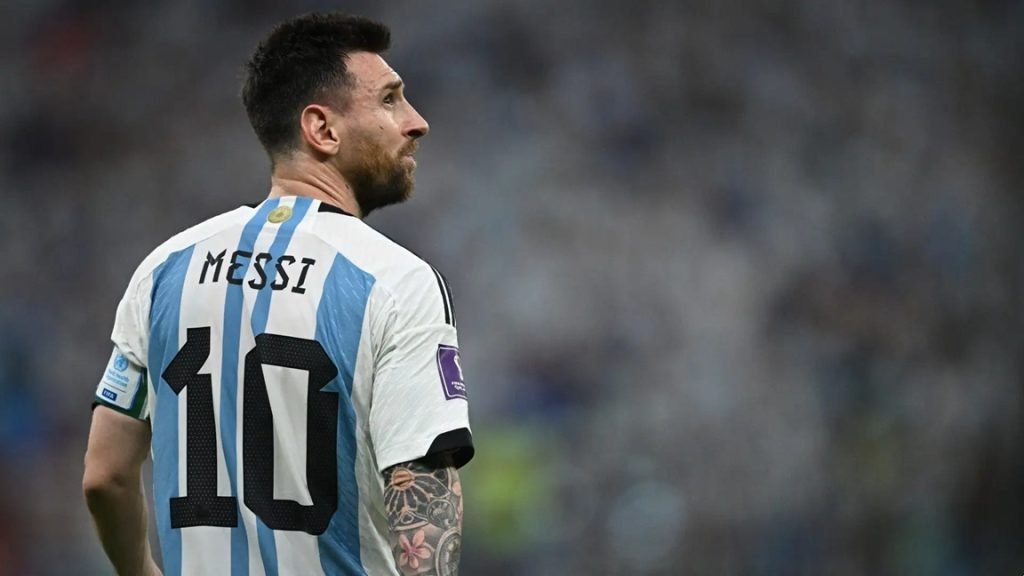

Lionel Messi has officially retired from international football at the age of 39, bringing an extraordinary 21-year career with Argentina to an end after the country’s defeat to Spain in the 2026 FIFA World Cup final.
Messi confirmed his decision on Monday, August 31, through a message on Instagram, closing the international chapter of a career that produced 207 appearances and 125 goals for Argentina. He leaves as the country’s most-capped player and leading scorer.
The decision came weeks after Argentina’s 1-0 defeat by Spain in the World Cup final. FIFA reported that Messi had written his farewell message shortly after the final but waited before making it public.
Although the announcement ends Messi’s Argentina career, it does not signal his retirement from professional football. He is expected to continue playing for Inter Miami, where his current contract runs through 2028.
Messi’s senior international career started in August 2005 against Hungary. His debut lasted only a few seconds before he was sent off following an altercation with Hungary defender Vilmos Vanczák.
That difficult beginning offered little indication of what would follow.
Over the next two decades, Messi became the central figure of Argentina’s national team, carrying enormous expectations while repeatedly falling short in major finals.
His early senior career included a World Cup final defeat to Germany in 2014 and consecutive Copa América final losses in 2015 and 2016.
The pressure became particularly intense after the 2016 Copa América Centenario final against Chile. Messi missed Argentina’s first penalty in the shootout and subsequently announced his retirement from international football.
He reversed that decision months later, beginning the second phase of his Argentina career that would ultimately transform his legacy.
Messi’s relationship with Argentina changed dramatically after years of disappointment.
In 2021, he finally won a major senior international trophy when Argentina defeated Brazil 1-0 in the Copa América final at the Maracanã.
That success was followed by the 2022 FIFA World Cup in Qatar, where Messi captained Argentina to the title.
The final against France became one of the tournament’s defining matches. Messi scored twice as the game finished 3-3 after extra time before Argentina won the penalty shootout.
His major international honours include:
- 2021 Copa América
- 2022 Finalissima
- 2022 FIFA World Cup
- 2024 Copa América
- 2008 Olympic gold medal
- 2005 FIFA U-20 World Cup
The 2022 World Cup victory was particularly significant because it ended years of debate over whether Messi could reproduce his club success on the international stage.
Messi’s international story continued into the 2026 World Cup, where Argentina reached the final again.
The team ultimately lost 1-0 to Spain, denying Messi the chance to finish his international career with another World Cup triumph.
Nevertheless, reaching the final at 39 underlined his extraordinary longevity. Messi had now appeared at six World Cups — 2006, 2010, 2014, 2018, 2022 and 2026.
FIFA described the 2026 final as Messi’s final appearance for Argentina, bringing his national-team career to a definitive close.
The defeat also gave his retirement announcement a different emotional tone. Rather than ending with another international trophy, Messi’s final Argentina campaign concluded with a World Cup runners-up medal.
The scale of Messi’s contribution to Argentina can be seen in the numbers.
Lionel Messi’s Argentina record
- 207: International appearances
- 125: International goals
- 21: Years representing Argentina
- 6: World Cups played
- 1: World Cup title
- 2: Copa América titles
- 1: Finalissima title
- 1: Olympic gold medal
His 125 goals make him Argentina’s all-time leading scorer, while his 207 appearances put him at the top of the country’s appearance list.
The statistics only tell part of the story. Messi’s importance extended beyond scoring and assists, as he became Argentina’s captain and the defining player of a generation.
Messi’s departure leaves coach Lionel Scaloni with the difficult task of reshaping an Argentina team that has relied on the forward’s creativity, goals and leadership for more than a decade.
There is no direct replacement for a player who leaves as both the team’s leading scorer and most-capped footballer.
Argentina does, however, enter the post-Messi era as one of international football’s strongest teams. The generation developed under Scaloni has already demonstrated that it can compete for major honours, meaning the challenge now is to maintain that success without its most influential player.
For Messi, meanwhile, the next stage is club football.
The Argentine superstar remains committed to Inter Miami, allowing him to continue his playing career even after closing one of the most consequential chapters in international football.
Messi’s Argentina career travelled from an unexpectedly difficult debut and years of criticism to sustained success at the highest level.
He leaves after winning the trophy that had eluded him for much of his career and establishing records that may stand for generations.
His final international record — 207 matches, 125 goals and a World Cup triumph — places him among the most accomplished players in Argentina’s history.
After 21 years, Argentina must now learn to play without its iconic No. 10.