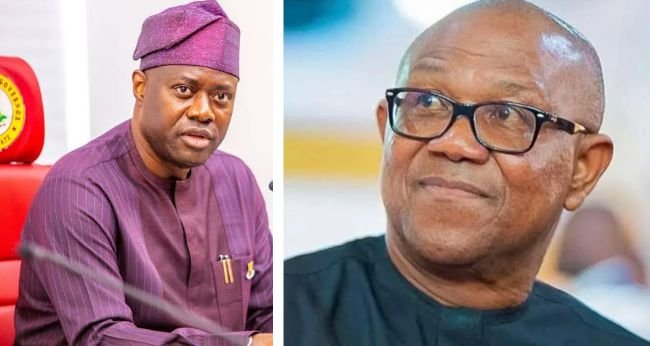

Oyo State Governor and Allied Peoples Movement (APM) presidential candidate Seyi Makinde has condemned the obstruction of Peter Obi’s convoy in Benue State, describing the incident as a troubling development ahead of the 2027 general election.
Obi, the presidential candidate of the Nigeria Democratic Congress (NDC), was travelling through Makurdi on Tuesday, September 8, 2026, to visit Yelwata in Guma Local Government Area, where he planned to meet families affected by the deadly June 2025 attack.
His convoy was stopped by youths who barricaded the Makurdi-Gboko federal highway, forcing the former Anambra State governor to abandon the planned visit. The Benue State Police Command later confirmed that the convoy had been blocked and said an investigation was underway to establish what prompted the incident.
Makinde’s reaction came amid conflicting accounts over who was responsible. While the NDC alleged that a Benue government aide led the group, the Benue State Government denied involvement and challenged those making the accusation to provide evidence.
In a statement issued by his Special Adviser on Media and Digital Communication, Anthony Ehilebo, Makinde said the obstruction was unacceptable and raised concerns about the treatment of opposition figures ahead of the 2027 elections.
The APM presidential candidate argued that political disagreements should not translate into restrictions on the movement of political candidates or other citizens.
Makinde particularly questioned the circumstances surrounding the roadblock, which occurred shortly after Obi arrived in Benue for his planned visit to Yelwata.
The incident also attracted attention because Obi had attended the inauguration of Makinde’s presidential campaign office in Abuja on September 7, one day before his Benue visit.
Makinde called for those responsible to be identified and held accountable through the appropriate legal process.
Makinde’s Main Concerns
The governor’s position centred on several issues:
- The right of opposition politicians to move freely across the country.
- The need to prevent political violence ahead of 2027.
- Accountability for those who mounted the roadblock.
- The responsibility of security agencies to protect political actors and citizens.
- The importance of maintaining a peaceful electoral environment.
Obi arrived in Makurdi on Tuesday morning and headed towards Yelwata, where he intended to sympathise with victims and relatives of people killed in the June 2025 violence.
The journey was disrupted when youths blocked the road near the Makurdi-Gboko route. Reports said the protesters prevented the convoy from continuing towards Yelwata.
Obi subsequently appealed to security agencies to investigate the incident. He said he chose not to force his way through the crowd because doing so could have escalated the situation and put lives at risk.
The NDC subsequently accused suspected hired thugs of carrying out the obstruction and alleged that a Benue government aide was involved.
That allegation has not been independently established.
The police, however, confirmed that the blockade occurred. Commissioner of Police Cletus Nwadiogbu said security personnel had been assigned to protect Obi’s movement and that investigators would establish why the youths blocked the convoy.
The Benue State Government has strongly rejected claims that it ordered or organised the obstruction.
Commissioner for Information and Culture Solomon Lorpev said Governor Hyacinth Alia was not officially aware of Obi’s visit and argued that the former Anambra governor should have followed the relevant protocol for such a visit.
The government’s position contrasts with the NDC’s account.
The opposition party said the visit was primarily humanitarian and alleged that a government-linked individual was involved in stopping Obi.
The disagreement has therefore produced two separate questions: whether Obi’s visit was properly communicated to the state authorities and who was responsible for the youths who blocked his convoy.
Neither question should be treated as conclusively resolved until the police investigation establishes the facts.
The police confirmation is significant because it separates the established incident from the disputed allegations surrounding it.
What is currently established is that:
- Obi travelled to Benue on September 8.
- His convoy was stopped on the Makurdi-Gboko road.
- The obstruction prevented him from reaching Yelwata.
- Police personnel were assigned to his movement.
- The police opened an investigation into the incident.
- Claims of state sponsorship remain disputed.
Obi’s intended destination, Yelwata, became the scene of one of Benue’s most devastating recent attacks in June 2025.
He said his planned visit was aimed at offering condolences and solidarity to families affected by the violence.
The NDC has repeatedly framed the visit as a humanitarian engagement, while Obi’s broader political activities in Benue and elsewhere have taken place against the backdrop of preparations for the 2027 presidential election.
That overlap between political activity and a visit to a community affected by violence has made the incident particularly sensitive.
For opposition parties, the blockade raises concerns about political tolerance and freedom of movement. For the Benue Government, the dispute centres on whether it is being wrongly blamed for an incident it says it did not authorise.
Makinde’s intervention adds another political dimension to the controversy.
His condemnation reflects broader concerns among opposition figures that incidents involving roadblocks, political intimidation or alleged attacks could undermine confidence in the 2027 electoral process.
However, the allegation that the youths were state-sponsored remains a claim rather than an established fact.
The Benue Government has demanded evidence from those making the allegation, while the police have said their investigation will establish the circumstances behind the blockade.
The outcome of that investigation could therefore determine whether the incident was an isolated confrontation, a security failure, a politically motivated action or something else.
Makinde’s response has put renewed focus on the responsibility of security agencies to protect political candidates and ensure that legitimate political activity can take place without intimidation.
The incident also underscores the importance of clear communication between political parties, security agencies and state authorities when high-profile political figures travel.
For now, the confirmed fact is that Peter Obi’s convoy was obstructed and that the police are investigating the circumstances.
Whether any government official or political group directed the action remains unresolved.
As the 2027 election approaches, the handling of this case could become an early test of how authorities respond to allegations of political intimidation and how effectively they protect the rights of opposition candidates.